Blog
Belviq recall: cancer findings and what patients can do
In this article
An old prescription bottle can turn a historical drug warning into a current question. Say you find unused Belviq tablets behind the thermometer: does the Belviq recall mean the bottle was faulty, that you need cancer tests, or that you should never have taken it? On February 13, 2020, FDA requested the withdrawal of Belviq and Belviq XR, both containing lorcaserin, from the US market because it judged that the potential cancer risk outweighed the benefits. Its instructions addressed each of those concerns. 1
The Acomplia Report's coverage of rimonabant's 2008 suspension gives this story a useful historical reference. We're an independent news archive that tracked that weight-loss drug from its trials to its removal from the market. Lorcaserin reached a similar regulatory endpoint for a different safety concern. The comparison helps explain why a drug that works can still lose its place in treatment.
What did the Belviq recall actually change?
A headline about a “recall” can sound like a problem with one production batch. You might expect a pharmacist to check a lot number and replace the bottle. That wasn't the decision FDA announced for lorcaserin.
FDA's February 2020 communication requested a voluntary withdrawal from the US market. The manufacturer submitted a request to withdraw the drug. The agency told health professionals to stop prescribing and dispensing lorcaserin, and told patients to stop taking it and discuss alternatives. Both Belviq and the extended-release version, Belviq XR, were covered. There wasn't an unaffected formulation identified in the notice. 1
“Voluntary” describes the manufacturer's role in the withdrawal process; it doesn't mean FDA left continued prescribing as an equally acceptable option. And “withdrawal” here describes a decision about the medicine's overall benefit–risk balance, rather than an exchange of suspect bottles for fresh stock.
For you, the useful check is the active ingredient, lorcaserin, rather than just the name on the front of the packaging. An old supply doesn't become suitable because it predates the announcement. Nor does switching from the regular tablet to XR answer the safety concern: FDA's notice covered both.
Why did a reassuring heart trial lead to withdrawal?
An older article may describe lorcaserin as cardiovascularly safe. If you read it beside the withdrawal notice, the two can seem contradictory. They're answering different questions.
Bohula et al. (2018), in the New England Journal of Medicine, reported CAMELLIA-TIMI 61, a randomized, double-blind, placebo-controlled trial involving 12,000 people who were overweight or had obesity and had cardiovascular disease or multiple cardiovascular risk factors. Lorcaserin acts on the serotonin 2C receptor to affect appetite. The trial's main safety question concerned cardiovascular death, heart attack or stroke.
During a median follow-up of 3.3 years, that combined outcome occurred at rates of 2.0% per year with lorcaserin and 2.1% per year with placebo. The hazard ratio was 0.99, with a 95% confidence interval of 0.85–1.14. The trial met its specified noninferiority criterion: it excluded an unacceptable increase in that cardiovascular endpoint under the trial's rules. It didn't establish freedom from every serious harm.
There was a weight-loss benefit. At one year, at least 5% weight loss occurred in 1,986 of 5,135 assessed participants receiving lorcaserin, or 38.7%, compared with 883 of 5,083 receiving placebo, or 17.4%. Those denominators matter. The response percentages don't describe all 12,000 randomized participants.
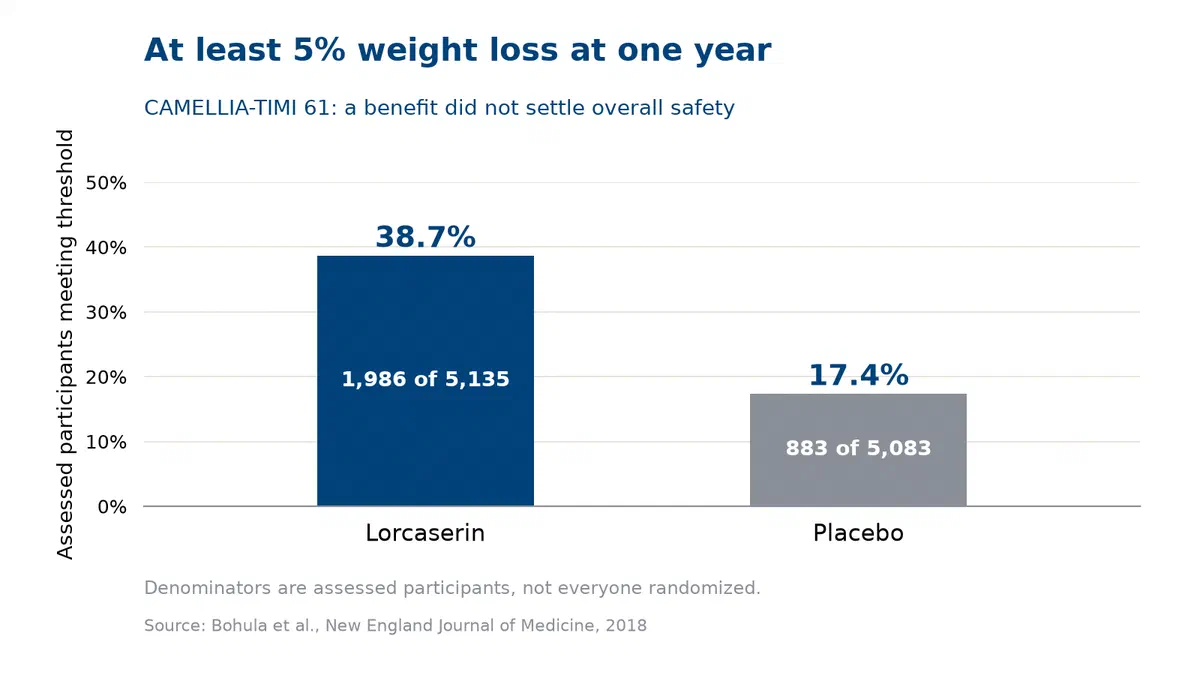
When comparing drug claims, you can ask what “safe” refers to. A cardiovascular endpoint isn't a cancer endpoint. The same distinction matters when reading the archived rimonabant trial summaries: evidence of weight loss and metabolic improvement doesn't settle the later benefit–risk decision.
How large was the cancer imbalance?
A percentage without its comparator can frighten more than it informs. Hearing that 7.7% of lorcaserin participants were diagnosed with cancer doesn't tell you how many cancers occurred without the drug.
FDA's completed review found cancer diagnoses in 462 people receiving lorcaserin, or 7.7%, compared with 423 receiving placebo, or 7.1%. Using the agency's rounded percentages, the difference is 7.7% − 7.1% = 0.6 percentage points. The difference in people diagnosed is 462 − 423 = 39 over the trial. These are two descriptions of the observed imbalance, not proof that the drug caused each additional person's cancer. 1
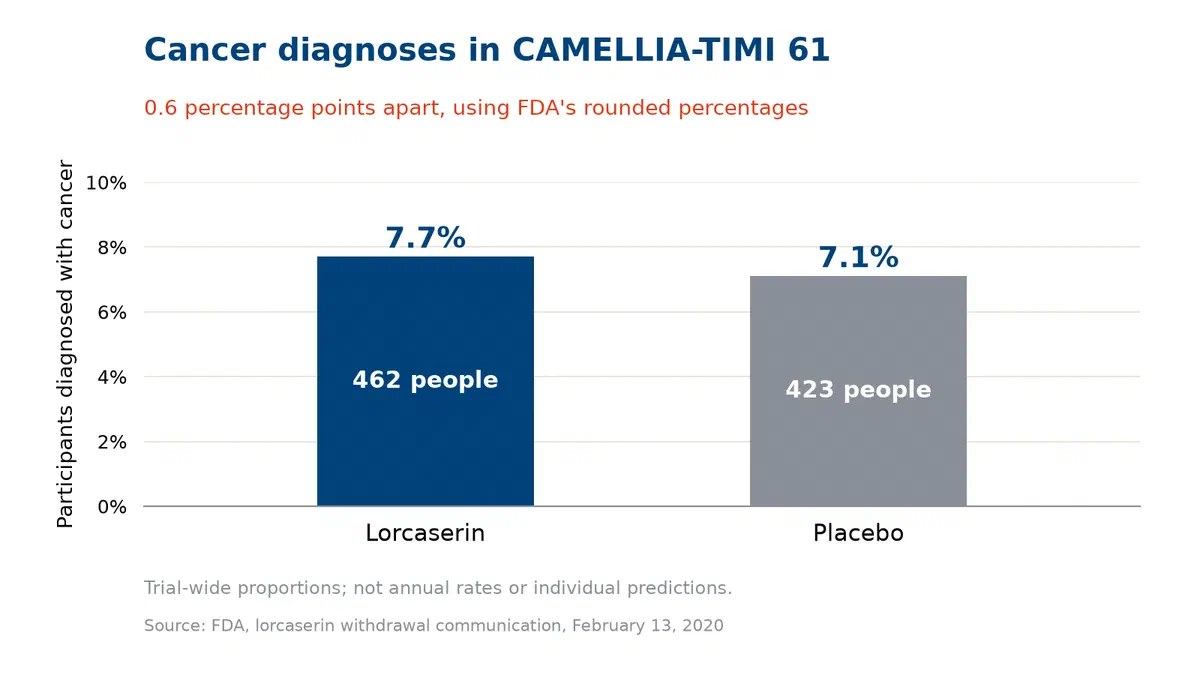
People and cancers are different counts. FDA reported 520 primary cancers among the 462 affected lorcaserin participants, versus 470 cancers among the 423 affected placebo participants. Some people had more than one primary cancer. Pancreatic, colorectal and lung cancers contributed to the imbalance. FDA also reported that the difference increased with longer treatment duration. 1
The agency summarized the finding as one additional cancer observed per 470 patients treated for one year. That's a rate-based description, not a promise about what will happen to one former user. It shouldn't be substituted for the trial-wide percentages, which cover a longer observation period.
You may also see “five-year trial” in FDA's summary. That doesn't mean every participant took the medicine for five years. The detailed notice gives January 2014 to June 2018 as the study period and a median follow-up of three years and three months. Keeping calendar duration separate from personal exposure prevents an easy misreading. 1
What does the FDA notice ask you to do?
A saved January warning can send you in the wrong direction. For example, a screenshot saying that FDA was still reviewing the cancer signal might leave you thinking its only instruction was to discuss the uncertainty.
The January 14, 2020 communication said the cause was uncertain and that FDA couldn't yet conclude lorcaserin contributed to cancer risk. 2 The February 13 update followed the completed review and instructed patients to stop taking lorcaserin. The later communication superseded the earlier treatment advice. 1
You don't need to interpret that as a diagnosis. FDA did not recommend special cancer screening for people who had taken lorcaserin. It said standard screening recommendations should be implemented. “No special screening” doesn't mean “ignore symptoms” or “skip ordinary screening”; it means prior use alone wasn't a reason for a separate testing program in this notice. 1
A conversation with your clinician can be more useful if you have the medicine name and approximate treatment dates available. You can ask how your usual cancer screening schedule applies, whether any symptoms need assessment, and what weight-management options fit your current health and other medicines. You don't have to choose a replacement from an old article.
This is an explanation of FDA's published instructions, not an individual treatment plan. Acomplia Report doesn't sell drugs or give personal medical advice. If you're currently taking a product labelled lorcaserin, FDA's withdrawal instruction is the relevant starting point for a prompt conversation with your prescriber or pharmacist.
What can you do with leftover lorcaserin pills?
Keeping a withdrawn medicine “just in case” creates a practical risk. Say a bottle remains beside your regular prescriptions: it could be mistaken for something still in use, even if nobody intends to restart it.
FDA's lorcaserin notice recommends a drug take-back location as the preferred disposal route. A pharmacist can help you establish whether a local collection service accepts the medicine. The agency's general disposal guidance also recognizes prepaid medicine mail-back envelopes. You don't need to keep the tablets while deciding on a replacement treatment. 1 3
If a take-back location or mail-back option isn't readily available, FDA gives a household-trash method:
- You can remove the tablets from their original container and mix them with an unappealing material, such as used coffee grounds or cat litter, without crushing them.
- The mixture goes into a sealed bag or another closed container, which helps prevent spills.
- That sealed container can go into your household trash.
- Personal information on the empty prescription label can be scratched out before the packaging is discarded or recycled where accepted. 1 3
The unappealing mixture makes the medicine less attractive to children, pets or someone looking through rubbish; the closed container keeps it contained. Removing label details protects your privacy. For lorcaserin, these are the drug-specific instructions FDA supplied. A general instruction to flush some dangerous medicines doesn't replace them.
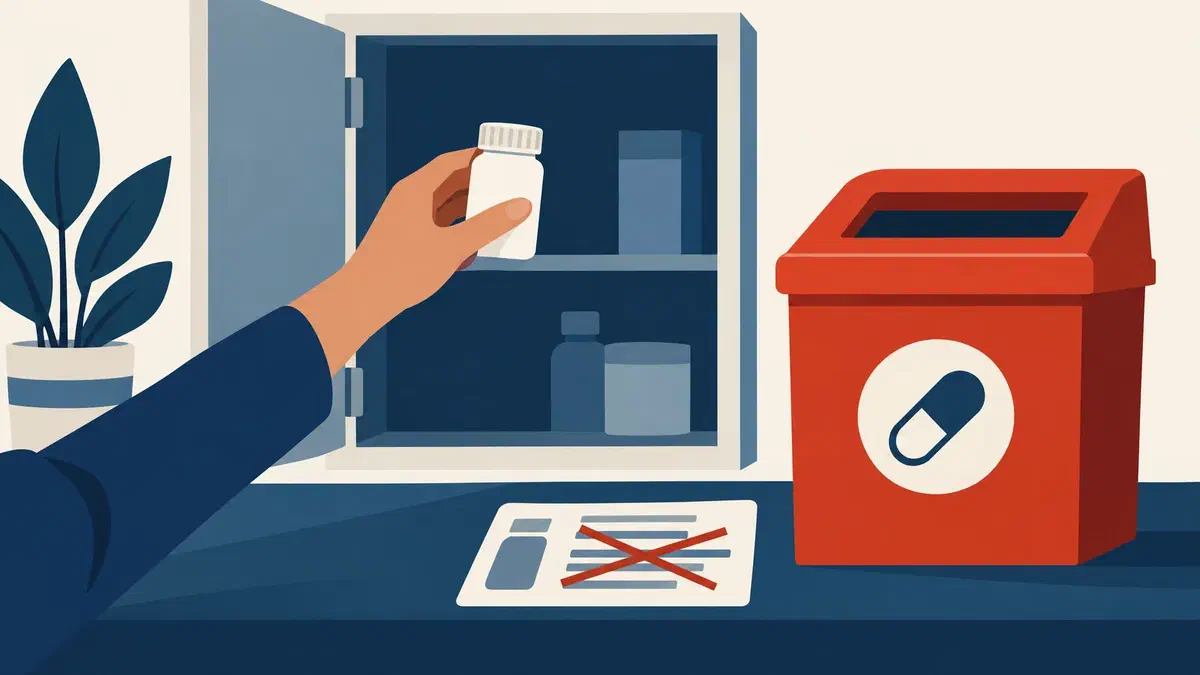
Before disposal, you can record the drug name and treatment dates if they're missing from your medical history. You don't need to retain the tablets to retain that information.
How does Acomplia's 2008 suspension compare?
Two drugs disappearing from the market can look like the same event. You might expect the stopping advice to match. But the regulator's exact instructions matter more than the shared headline.
On October 23, 2008, the European Medicines Agency recommended suspension of Acomplia's marketing authorization across the EU. Its committee concluded that the benefits no longer outweighed the risks and described an approximate doubling of psychiatric-disorder risk compared with placebo. The concern was psychiatric harm, particularly depression, rather than the cancer imbalance that drove lorcaserin's withdrawal. 4
EMA also judged that further risk-reduction measures couldn't adequately address the psychiatric effects. It noted that effectiveness in ordinary practice was more limited than expected because patients generally used Acomplia for only a short period. A favorable weight-loss result couldn't cancel those concerns. 4
The patient instructions differed. EMA said there was no need to stop Acomplia immediately and advised a discussion with a doctor or pharmacist at a convenient time. FDA's lorcaserin notice explicitly said patients should stop taking it. Those historical instructions aren't interchangeable. 1 4
A suspension was a precautionary measure during which the product wasn't available; EMA said lifting it depended on resolving the identified issues. That procedural meaning differs from FDA's request for voluntary withdrawal. Our rimonabant side-effect archive and coverage of the 2007 FDA panel record the earlier debate. The practical lesson is to read the action and patient instruction, not just the drug's disappearance from sale.
Questions about lorcaserin withdrawal
A search result often compresses several concerns into one sentence. If your question is about testing rather than disposal, the distinction below can save you from applying the wrong part of the notice.
Was the Belviq recall caused by contamination?
FDA's February 2020 reason was a cancer imbalance in a randomized safety trial and a judgment that risks outweighed benefits. It wasn't presented as a contamination problem involving a particular batch. The instruction covered Belviq and Belviq XR. 1
Do former lorcaserin users need extra cancer screening?
FDA didn't recommend special screening solely because someone had taken lorcaserin. Standard screening still applied. If you're worried about a symptom or your screening schedule, your clinician can assess that concern rather than assume exposure alone requires extra tests. 1
Can I keep taking pills prescribed before the withdrawal?
FDA's instruction wasn't limited to new prescriptions. It told patients to stop taking lorcaserin and discuss alternative medicines or weight-management programs with health professionals. A bottle prescribed earlier doesn't sit outside that instruction. 1
A recorded exposure history is more useful than an old bottle
Years later, the remaining problem may be an incomplete medication list. You might remember “a diet tablet” but not its name or how long you took it. That leaves your clinician with a less useful history than the prescription record could provide.
A note containing lorcaserin's name, approximate start and stop dates, and any concerns you remember can support a better discussion. A pharmacy record may help if you can't reconstruct the dates. The pills themselves can't answer whether you need routine screening or a different weight-management approach. Their useful information belongs in your medication history; the unused supply belongs in the disposal route FDA described.
Main trial citation: Bohula EA et al. Cardiovascular Safety of Lorcaserin in Overweight or Obese Patients. New England Journal of Medicine. 2018;379:1107–1117. doi: 10.1056/NEJMoa1808721.