Blog
Quit smoking weight gain: averages, risks and planning
In this article
Quit smoking weight gain can make a successful quit attempt feel like a setback. Say you've stopped buying cigarettes, but your work trousers feel tighter a month later. That's frustrating. It doesn't mean quitting was a mistake: a BMJ meta-analysis found an average gain of about 4–5 kg after a year, with large differences between individuals. You can plan for the change without making a motionless scale the test of success. 1
The Acomplia Report's smoking-cessation archive belongs to an independent news site that tracked rimonabant from its trials to its 2008 withdrawal. This question is part of that history: researchers once tested whether the drug could help people stop smoking while limiting weight gain.
How much quit smoking weight gain is typical?
An average can sound like a promise. If a friend gained nothing after quitting, you might expect the same; if someone else gained a great deal, you might fear that outcome. Neither story predicts your result.
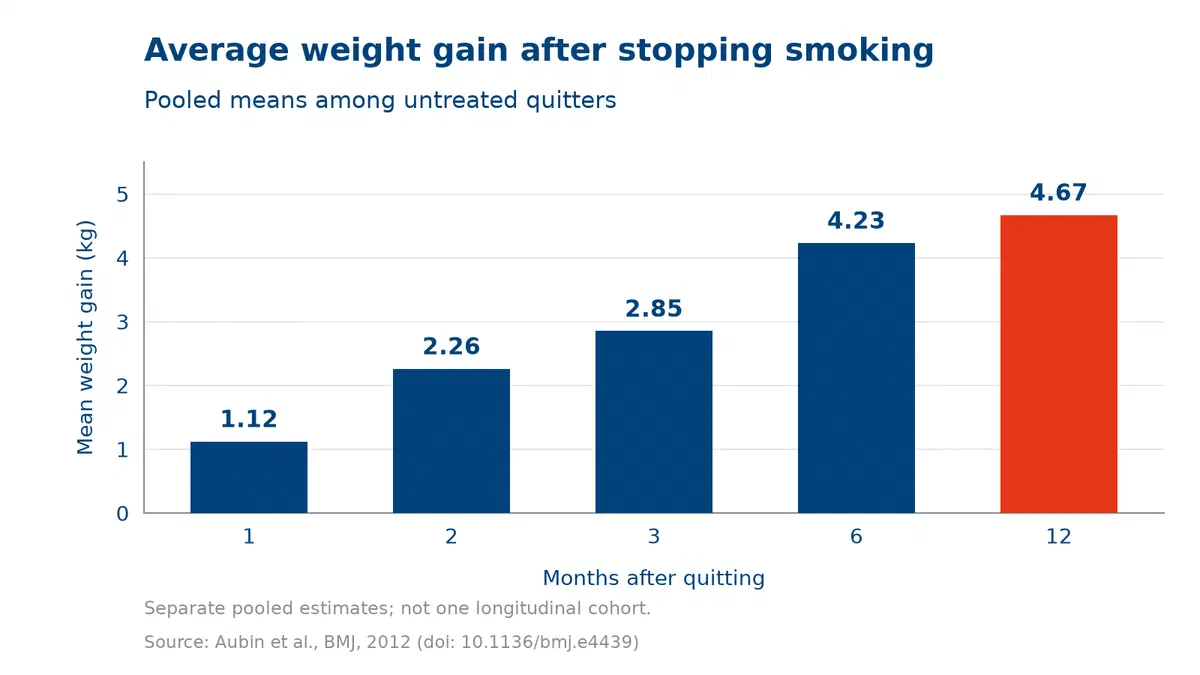
Aubin et al. (2012), in BMJ, included 62 studies in their meta-analysis. Among quitters without active treatment, pooled mean weight gain was 1.12 kg at one month, 2.26 kg at two months, 2.85 kg at three months, 4.23 kg at six months and 4.67 kg at 12 months. Most gain occurred during the first three months. 1
For a US reader, the final estimate is about 10.3 lb. Using the conversion factor 2.20462 lb/kg, 4.67 kg × 2.20462 lb/kg = 10.2955754 lb, rounded to one decimal place. That's a group average, not a target or a limit.
The authors also estimated the spread of outcomes at 12 months: 16% lost weight, 37% gained less than 5 kg, 34% gained 5–10 kg and 13% gained more than 10 kg. These percentages were modeled from pooled means and standard deviations, assuming an approximately normal distribution; they weren't direct counts from one trial. 1
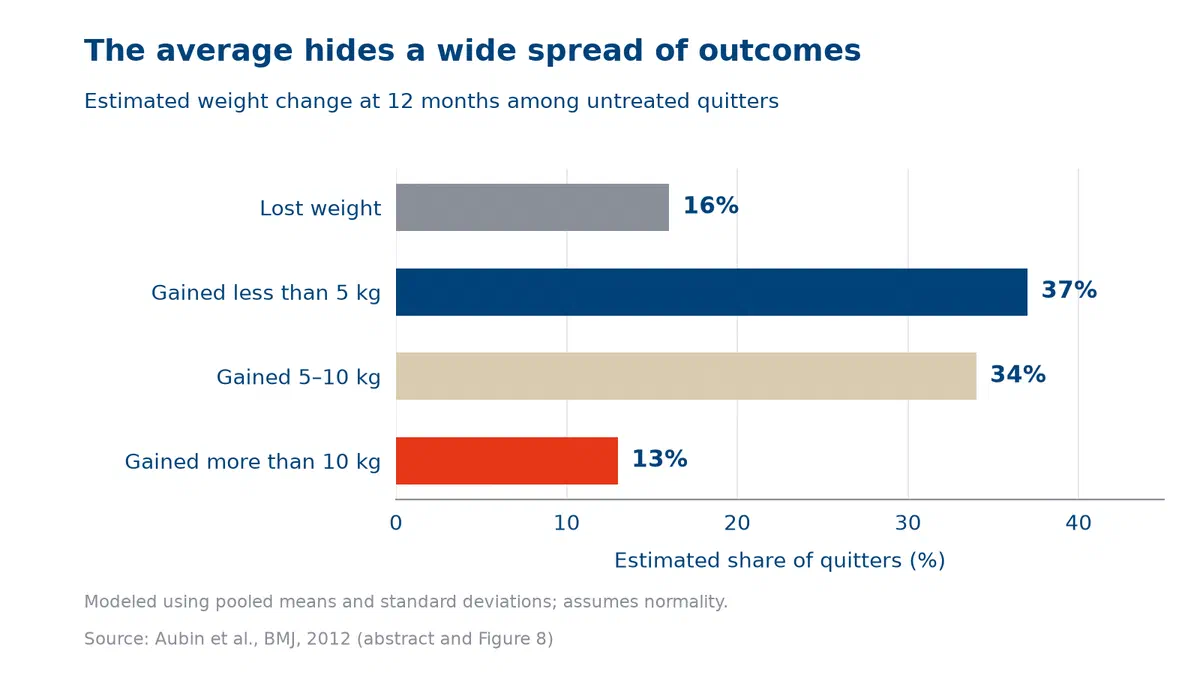
You can use these estimates to arrange early support. You don't need to assume you'll gain the average amount—or treat a larger gain as something you must tolerate without help.
Why does appetite change after you stop smoking?
The missing cigarette can change both hunger and routine. Say your afternoon break used to involve smoking outside; now you're at the vending machine, even after lunch. Biology and habit may both be involved.
Audrain-McGovern and Benowitz (2011), in Clinical Pharmacology & Therapeutics, explain that nicotine increases energy expenditure and suppresses appetite. When nicotine exposure stops, energy expenditure can fall and food intake can rise. Food may also become a substitute source of reward during withdrawal. 3
That doesn't support a fixed calorie rule for every quitter. Your activity, eating pattern and starting weight differ from someone else's. A calculation that promises an exact gain from an exact metabolic slowdown gives more certainty than the evidence allows.
A useful planning question is: “Am I hungry, craving a cigarette, or repeating a break-time habit?” A brief record of the time, feeling and response may help you discuss the pattern with a cessation counselor. It isn't a diagnostic test. If the break itself is the trigger, a different routine may be easier to maintain than repeatedly arguing with yourself beside the snack machine.
Nicotine's appetite effects also don't make cigarettes a reasonable weight-control tool. Lower body weight doesn't prove better metabolic health; the same review discusses smoking's links with insulin resistance and abdominal fat. 3
Does extra weight cancel the health benefits of quitting?
Weight is easy to see; a change in future disease risk isn't. If your scale rises while your breathing feels much the same, the visible change can dominate your judgment. The appropriate comparison is with continuing to smoke, not with an imaginary quit attempt free of every drawback.
Hu et al. (2018), in The New England Journal of Medicine, examined three prospective US cohorts. Recent quitters—defined as people who had stopped two to six years earlier—had a higher risk of type 2 diabetes than current smokers: hazard ratio 1.22, with a 95% confidence interval of 1.12–1.32. A hazard ratio compares event rates over follow-up; it doesn't give your personal probability of diabetes. 4
The temporary increase was related to weight gain. It wasn't seen in quitters without gain. But quitting was associated with lower cardiovascular and all-cause mortality regardless of weight change, including substantial gain. 4
So the trade-off still favors quitting. Weight deserves attention because it can affect health, but it doesn't erase the mortality benefit in these data. These were observational cohorts, which means the findings don't prove that gaining weight itself is protective.
If you have diabetes, prediabetes or concern about increasing weight, you can ask your clinician how to review glucose control during the quit attempt. That addresses a real risk without using cigarettes as a response to it.
Which weight-management strategies have evidence?
A confident prevention claim can raise an unrealistic expectation. Say a program promises that you can quit without gaining a pound. Before accepting that promise, you need to know whether its evidence covers the treatment period or an entire year.
Hartmann-Boyce et al. (2021), in the Cochrane review, reached this conclusion: 2
“Overall, there is no intervention for which there is moderate certainty of a clinically useful effect on long-term weight gain.”
This doesn't mean support is pointless. It means you shouldn't expect any tested method to guarantee lasting prevention.
Do cessation medicines prevent weight gain?
A medicine can help with one goal without settling another. If you're comparing quit-smoking treatments by weight alone, a small early difference may distract you from cessation effectiveness and safety.
Cochrane found that nicotine replacement therapy reduced weight gain by an average of 0.52 kg relative to control at the end of treatment. Bupropion's corresponding difference was 1.01 kg. Varenicline's estimated difference was only 0.23 kg, and its confidence interval included no difference. These are between-group differences, not the total amount participants gained. 2
Long-term benefits were uncertain or modest. Those results don't justify choosing, extending or combining medicines on your own to control weight. Your clinician or pharmacist can help compare cessation options against your medical history and other medicines. The main purpose is to stop smoking; any early weight benefit is a separate consideration.
What about exercise and food support?
A leaflet may tell you to eat less without addressing the late shift when cravings hit. That gap helps explain why “weight advice” and sustained support aren't interchangeable.
Personalized weight-management programs showed possible short-term benefit, but longer-term effects were uncertain. Evidence about their effect on quitting was mixed and of low certainty. It doesn't establish that all simultaneous weight management causes relapse, or that every diet program is harmless to a quit attempt. 2
Exercise interventions were associated with 2.07 kg less gain at 12 months, but that estimate came from just three studies with 182 participants. The evidence was low certainty, and there wasn't a clear effect at treatment end. It's a reason for interest, not a dependable forecast. 2
You can discuss a sustainable activity routine and realistic meal planning with your care team. A plan that fits your day is easier to repeat; the review doesn't establish how much weight it will prevent. If food restriction intensifies cravings or distress, that belongs in the conversation too.
Why was rimonabant tested for this problem?
The appeal of a drug that could address cigarettes and weight is obvious. A smoker worried about tighter trousers might find the early headlines persuasive. The later results show why the follow-up period and safety evidence matter.
Rimonabant acted at the cannabinoid CB1 receptor, part of a system involved in appetite and reward. Our endocannabinoid-system explainer describes that background, and the STRATUS-US trial archive records the original smoking-cessation research.
Robinson et al. (2018), in Addiction Biology, pooled three trials: STRATUS-EU, STRATUS-US and STRATUS-META. Treatment lasted 10 weeks, with the quit date set after the first two weeks. The experimental 20 mg arm improved smoking abstinence relative to placebo. 5
Among abstainers across the three trials, adjusted mean weight gain from the pre-medication baseline to treatment end was 0.92 kg in that rimonabant arm versus 3.03 kg with placebo. But at 48 weeks after the target quit date, the pooled EU/US analysis found no statistically significant weight difference, including among abstainers. The early weight effect wasn't a demonstrated lasting solution. 5
These are historical trial doses, not treatment instructions. Sanofi-Aventis funded the original trials and supplied the dataset; the paper states that the company did not analyze or interpret the data for that manuscript. 5
On October 23, 2008, the EMA recommended suspending Acomplia's marketing authorization. It reported approximately twice the risk of psychiatric disorders versus placebo in obese or overweight patients and concluded that benefits no longer outweighed risks. That population-specific estimate shouldn't be copied onto the smoking trials. 6
The rimonabant side-effects archive adds historical context. Rimonabant isn't a current cessation option, and an online offer isn't evidence that it is safe or approved.
How can you plan without making weight the main test?
Good intentions often fail at a specific moment. Say you finish a night shift hungry, tired and craving the cigarette you used to smoke beside the car. A workable plan addresses that moment before it arrives, rather than demanding perfect restraint afterward.

A baseline gives the discussion a reference point. You can note your weight before quitting and ask your clinician what follow-up makes sense. If weighing increases anxiety or you have an eating-disorder history, you can discuss another way to monitor progress. The purpose is useful information, not a daily verdict.
A routine can address a recurring trigger. If the drive home is the problem, having a planned meal or snack available may reduce unplanned eating. A non-food break can address the ritual instead. These are practical responses to the appetite and reward changes described in the nicotine review, not proven guarantees against gain. 3
Follow-up can cover smoking and weight separately. You can record cravings, smoking lapses and weight changes as different observations. That makes it easier to ask for help with one problem without declaring the whole attempt unsuccessful. A cigarette lapse shouldn't become a reason to abandon cessation support.
Treatment questions can come before a purchase. Useful questions include: “Which cessation treatments fit my health history?” and “What will we do if appetite or weight becomes difficult?” Because early drug effects may fade, you can also ask what happens after treatment ends. Cochrane's findings support that distinction between short-term control and lasting benefit. 2
A plan needs room for revision. If the scale rises faster than expected, or cravings are pushing you back to cigarettes, you can bring the record to a clinician or counselor rather than responding with an extreme diet or an unapproved drug.
Questions readers ask about weight after quitting
A single weigh-in rarely answers the question you're worried about. For example, a gain early in a quit attempt doesn't tell you how much you'll weigh a year later. These answers separate group evidence from personal prediction.
How much weight do people gain after quitting smoking?
Aubin et al. (2012) found a mean gain of 4.67 kg at 12 months among untreated quitters. Individual changes varied widely, and the authors estimated that 16% lost weight. The mean isn't an inevitable outcome. 1
When does weight gain after quitting smoking slow down?
Most gain in the BMJ meta-analysis occurred within the first three months. The pooled means continued to rise between three and 12 months, so slowing doesn't necessarily mean stopping. Your own pattern may differ. 1
Can nicotine patches stop all the weight gain?
No guarantee is supported. Cochrane found a small average reduction during nicotine replacement treatment, with uncertain long-term benefit. Patches are cessation treatments, not a reason to self-manage nicotine for weight control. 2
Should I lose weight before I quit smoking?
The evidence doesn't support delaying quitting until you reach a particular weight. You can ask for help with both concerns; the mortality benefits of quitting remained in the NEJM cohorts despite weight gain. Individual medical needs still require discussion. 4
A rising scale should prompt support, not a return to cigarettes
A weight change can become a reason to postpone the next quit attempt. Say you're about to buy cigarettes because last time your clothes stopped fitting. That concern deserves a response, but continued smoking leaves the larger health problem in place.
The useful next conversation is specific: “Last time, appetite increased after work and I gained weight. How can we plan for that while helping me stay off cigarettes?” It gives your clinician or counselor a situation to address instead of an impossible promise to make.
This article explains research and doesn't provide individual medical advice. The Acomplia Report doesn't sell drugs. At your next cessation visit, you can bring the question that matters: what support will be available if weight becomes the reason you're tempted to smoke again?
References