Blog
Black box warning: what FDA labels do—and don't—tell you
In this article
A black box warning on a drug label means a serious risk deserves prominent attention before prescribing and during treatment. It doesn't automatically mean the medicine is banned, or that everyone who takes it will suffer the warned-about harm. The FDA calls it a boxed warning: a warning enclosed in a box in the prescribing information. 1
Say you're comparing a weight-loss prescription with a medicine to help you quit smoking. An alarming headline isn't enough to judge either one. You need the actual warning, the people it applies to, and the evidence behind it.
The Acomplia Report's independent rimonabant news archive tracked a weight-loss drug from promising trials to its removal from the European market. That history makes the distinction between a warning and a regulatory decision especially relevant here.
What does a black box warning mean?
A warning can name a frightening outcome without telling you how likely it is. For example, seeing “suicidal thoughts and behaviors” at the top of a label doesn't give you a personal risk estimate. The box identifies a problem that needs attention; the supporting sections explain more. 1 2
It's the FDA's most prominent prescription-label warning format. In its 2011 labeling guidance, the agency describes situations that may warrant a box: an adverse reaction serious enough to affect the benefit-risk decision, a serious reaction that appropriate use can prevent or reduce, or restrictions needed for safe use. Fatal or permanently disabling reactions are examples—not requirements for every box. 1
That means the useful question is, “What changes because this warning is here?” Sometimes the answer concerns which patients can receive the medicine. Sometimes it concerns monitoring or avoiding another drug. A box may also flag a risk associated with a drug class, even when that exact product hasn't produced the event in its own trials. 1
You can read the box as a short statement with a practical consequence. Which harm is named? Which people or circumstances are singled out? What does the label say the prescriber should do? Those questions work because the box is a summary, with references to fuller explanations elsewhere in the label. It isn't the whole safety assessment.
How is a warning different from a contraindication or withdrawal?
A medicine can have both a warning and a contraindication, and they needn't address the same risk. Contrave, for example, carries a suicidality warning but also lists uncontrolled hypertension and a seizure disorder or history of seizures as contraindications. Reading only the box would miss those separate restrictions. 2
A contraindication identifies a situation in which the drug should not be used. FDA guidance reserves this category for circumstances where the risk clearly outweighs any possible therapeutic benefit. A warning, by contrast, can describe a risk that still permits use with appropriate selection or precautions. A contraindication can also appear inside a box; the categories overlap rather than form separate levels on a ladder. 1
Withdrawal or suspension concerns whether a product remains available under its authorization. It isn't just stronger wording on the same label.
Rimonabant illustrates the difference. EMA's October 2008 statement records a July 2007 restriction against Acomplia use in patients with ongoing major depression or those receiving antidepressants. On October 23, 2008, the agency recommended suspending its marketing authorization because benefits no longer outweighed risks and further risk-reduction measures wouldn't adequately address psychiatric harm. 3
Our report on Acomplia's removal from the European market preserves that contemporary news. The practical lesson is to separate two questions: “What does the label restrict?” and “Is this medicine authorized and available here?” An old label can't answer the second question today.
Why does Contrave carry a warning about suicidal thoughts?
A weight-loss medicine may contain an ingredient used for another purpose. Contrave combines naltrexone with bupropion, an antidepressant ingredient also used in smoking cessation. That can make its psychiatric warning seem unexpected if you're looking only at the weight-loss indication. 2
The prescribing information revised in November 2025 carries the heading:
WARNING: SUICIDAL THOUGHTS AND BEHAVIORS
The box explains that antidepressants increased suicidal thoughts and behavior in children, adolescents, and young adults in short-term trials. It calls for close monitoring of patients of all ages who start Contrave. Contrave isn't approved for pediatric patients or for treating depression. It also isn't approved to help people quit smoking. 2
The age differences matter. Section 5.1 reports pooled antidepressant-trial risk differences per 1,000 patients treated: 14 additional cases of suicidality below age 18, 5 additional cases at ages 18–24, 1 fewer case at ages 25–64, and 6 fewer cases at age 65 or older, compared with placebo. These are antidepressant-trial estimates, not measurements from Contrave weight-loss trials. “Suicidality” here covers suicidal thinking and behavior; it doesn't mean deaths alone. 2
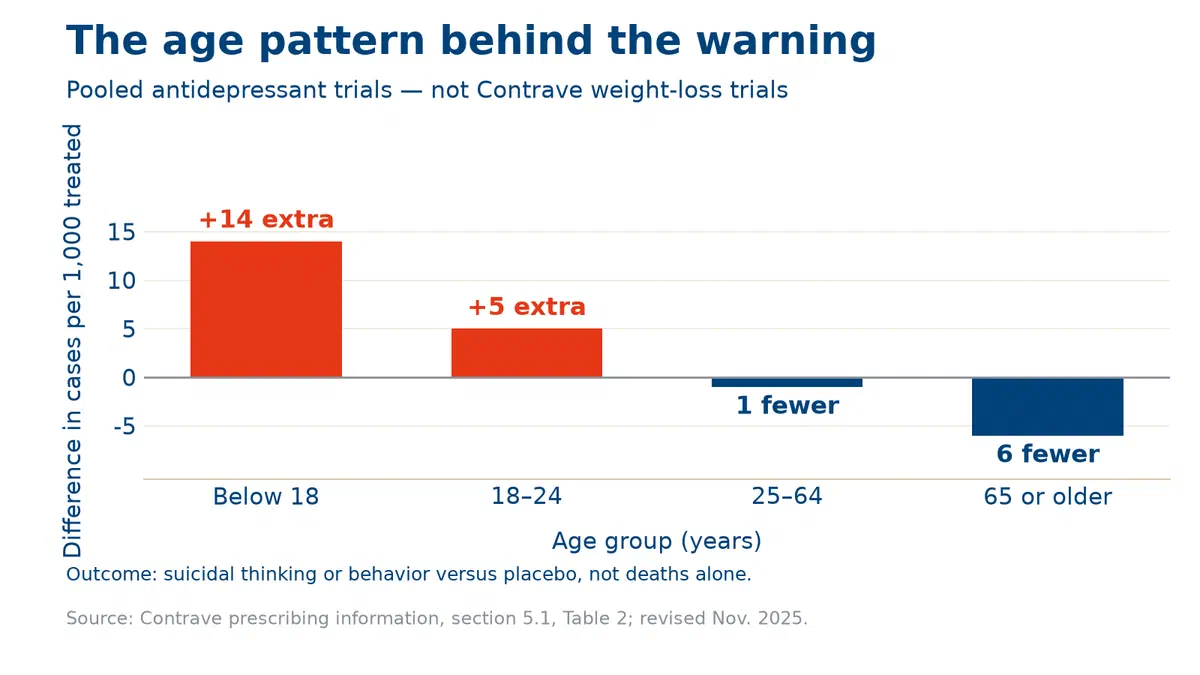
The distinction prevents two mistakes. A younger reader shouldn't dismiss the warning because the prescription is for weight loss. An older reader shouldn't treat an age-group average as permission to ignore new mood symptoms. The box's monitoring instruction applies across ages. 2
There's another detail worth reading beside the box. In adult Contrave obesity trials lasting up to 56 weeks, the label reports no suicides or suicide attempts. Suicidal ideation occurred in 1 of 3,239 Contrave participants and 3 of 1,515 placebo participants. Those small event counts don't establish that the drug prevents suicidal thoughts or that its risk is zero. 2
You can ask a clinician, “Which part of this warning applies to my history, and what would we monitor?” That question connects the class evidence to the actual prescribing decision without assuming that every warning has the same evidence base.
Why was varenicline's boxed warning removed?
An old search result can outlive a label change. A headline about Chantix from 2009 may describe a warning that wasn't present after the FDA revised the label in 2016. So the date is part of the medical information, not just a publishing detail.
Desai et al. (2019), in JAMA Network Open, document the addition of varenicline's boxed warning in July 2009 and its removal on December 16, 2016. The warning concerned serious neuropsychiatric effects, including suicidal thoughts and behavior. Its removal followed the EAGLES trial. 4
Anthenelli et al. published EAGLES online in The Lancet on April 22, 2016. The randomized trial compared varenicline, bupropion, nicotine patch, and placebo in 8,144 smokers, with and without psychiatric disorders. Treatment lasted 12 weeks, followed by 12 weeks without study treatment; participants received brief cessation counseling at visits. 5
The trial did not show a significant increase in its neuropsychiatric safety outcome attributable to varenicline or bupropion compared with nicotine patch or placebo. That's more informative than reports of symptoms without a comparison group, because events also occurred among people assigned placebo. 5
But removal of the box wasn't a promise that psychiatric symptoms could never occur. The event counts below make that clear. It's reasonable to ask which warnings remain in the current prescribing information, rather than relying on an old headline or assuming the whole safety discussion disappeared.
What do the EAGLES numbers actually tell you?
A chart headed “psychiatric side effects” can look like a chart of suicides, even when it measures something broader. EAGLES used a composite outcome—a defined group of moderate or severe neuropsychiatric adverse events. The percentages below aren't suicide rates. 5
Among participants without psychiatric disorders, the reported event rates were 1.3% with varenicline, 2.2% with bupropion, 2.5% with nicotine patch, and 2.4% with placebo. Among those with psychiatric disorders, rates were 6.5%, 6.7%, 5.2%, and 4.9%, respectively. 5
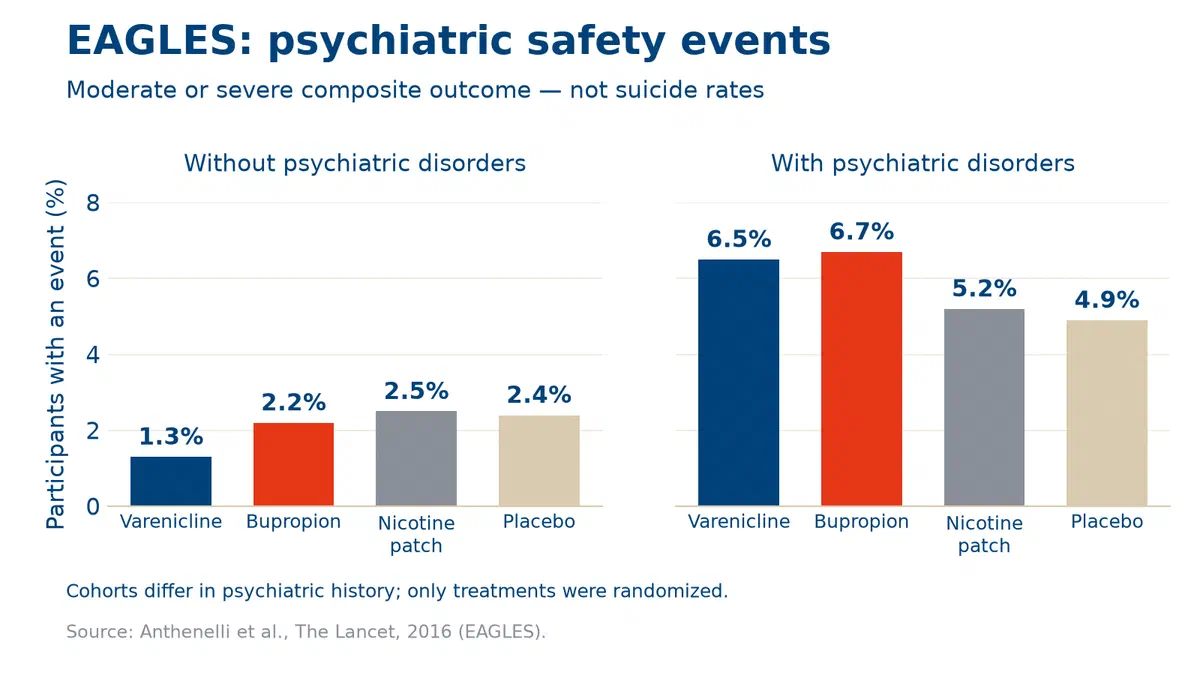
The psychiatric-cohort varenicline rate was numerically higher than placebo. Using the raw counts, the unadjusted difference is (67 ÷ 1,026 × 100) − (50 ÷ 1,015 × 100) = 1.604106… percentage points. The paper's reported analysis gives a difference of 1.59 percentage points, with a 95% confidence interval from −0.42 to 3.59. The slight difference reflects the paper's analysis rather than subtraction of the raw proportions. 5
Because that interval includes zero, the result did not establish an increased drug-attributable risk. It also doesn't prove that every possible increase is excluded. You can hold both points at once.
EAGLES was funded by Pfizer and GlaxoSmithKline, as the publication discloses. That funding deserves acknowledgment; it doesn't erase the randomized comparison. The sensible reading is the authors' stated result, alongside the outcome definition and uncertainty—not a claim that the study proved universal safety. 5
If absolute differences are unfamiliar, our guide to number needed to treat explains why the comparison group matters. Here, the first useful step is keeping an event rate separate from an estimate of extra events attributable to treatment.
Where can you find and read the current label?
A photograph of a medicine carton may omit the full warning. For example, the abbreviated warning in prescribing-information highlights directs you to the complete box; a cropped screenshot can lose that context. You need the full document for the exact product. 2
DailyMed, provided by the National Library of Medicine, hosts drug labeling in readable web and PDF formats. You can search by the brand or active ingredients, then match the formulation and product details to the medicine being discussed. In the Contrave entry cited here, “BOXED WARNING” is a separate section. 2 6
A workable reading order is:
- The full box, including who it concerns and any instructions it names.
- “Contraindications,” because separate restrictions may rule out use.
- The referenced “Warnings and Precautions” subsections, where evidence and monitoring details appear.
- The Medication Guide or other patient labeling, written for patients and caregivers.
This order works because it follows the label's own cross-references rather than treating the top panel as a complete answer. 1 6
For FDA-approved labeling, Drugs@FDA is the agency's approval database. You can search the medicine's name, open its approval record, and inspect the labeling and approval-history dates. A downloaded FDA label may itself say it isn't the latest approved version; that notice deserves attention.
DailyMed has a separate limitation: it carries company-submitted labeling currently in use and includes some products that aren't FDA-approved. A listing alone doesn't prove approval. The NLM's overview explains those categories. 6
For a treatment discussion, a saved label title, revision date, and relevant section are more useful than a screenshot with no source. They let a pharmacist or clinician check the same wording you're reading.
FAQ: questions readers ask about boxed warnings
A search snippet may reduce a long warning to a yes-or-no claim. These common questions are better answered with the label and its context beside you.
Does a black box warning mean a drug is unsafe?
It identifies a serious risk, but it doesn't automatically rule out all use. FDA guidance allows boxed warnings where selection, monitoring, or other precautions can reduce harm. The decision still depends on the medicine's benefits and the patient's circumstances. 1
Is a boxed warning the same as a contraindication?
No. A contraindication identifies circumstances where the drug should not be used. A box highlights prominent safety information and may include a contraindication, but the terms aren't interchangeable. 1
Does Contrave still have a boxed warning?
Yes. The prescribing information revised in November 2025 carries a warning on suicidal thoughts and behaviors. It links that warning to its bupropion component and calls for monitoring across ages. 2
Does Chantix still have its original psychiatric boxed warning?
The FDA removed varenicline's neuropsychiatric boxed warning on December 16, 2016, after EAGLES. That historical change doesn't replace reading the current product label for warnings and precautions. 4 5
A useful warning ends in a monitoring plan
A warning isn't much use if it leaves you with no idea what happens next. Say a caregiver notices a new, troubling change in mood after a relative starts a prescription. A vague instruction to “watch for side effects” offers less help than knowing which symptoms the label names and how to contact the prescriber.
For Contrave, the Medication Guide describes new or worsening changes in mood, behavior, thoughts, or feelings and gives instructions for contacting a healthcare professional. Those instructions are part of the safety information, not an optional appendix. 2
Before a prescription decision, you can ask: “What symptoms need a prompt call, who should notice them, and how will follow-up work?” The reason is practical. Monitoring requires someone to recognize a change and a route to report it.
This article explains labels, not individual treatment choices. A warning shouldn't become a reason to improvise dose changes from a blog post. The useful endpoint is a specific plan agreed with your clinician—and a current label you can both refer to.
References