Blog
Appetite suppressant: mechanisms, withdrawals and claims
In this article
An appetite suppressant is a substance that reduces hunger or helps you feel satisfied with less food. That description doesn't tell you whether it's a prescription medicine, a supplement with uncertain evidence, or a withdrawn drug. Say you're comparing a weekly injection with a bottle promising “natural hunger control” at the supermarket. They may share a claim, but they don't share a mechanism, a safety record or an approval process.
The Acomplia Report is the independent news archive that tracked rimonabant from its clinical trials to its removal from the European market in 2008. That history matters here: reducing appetite can produce real weight loss while causing harms that make a drug unacceptable. The site doesn't sell medicines or provide individual medical advice.
What does an appetite suppressant actually do?
A quieter urge to snack isn't the same outcome as better long-term health. For example, feeling less hungry during an afternoon shift doesn't establish that a product produces sustained weight loss, improves diabetes or is safe for your heart.
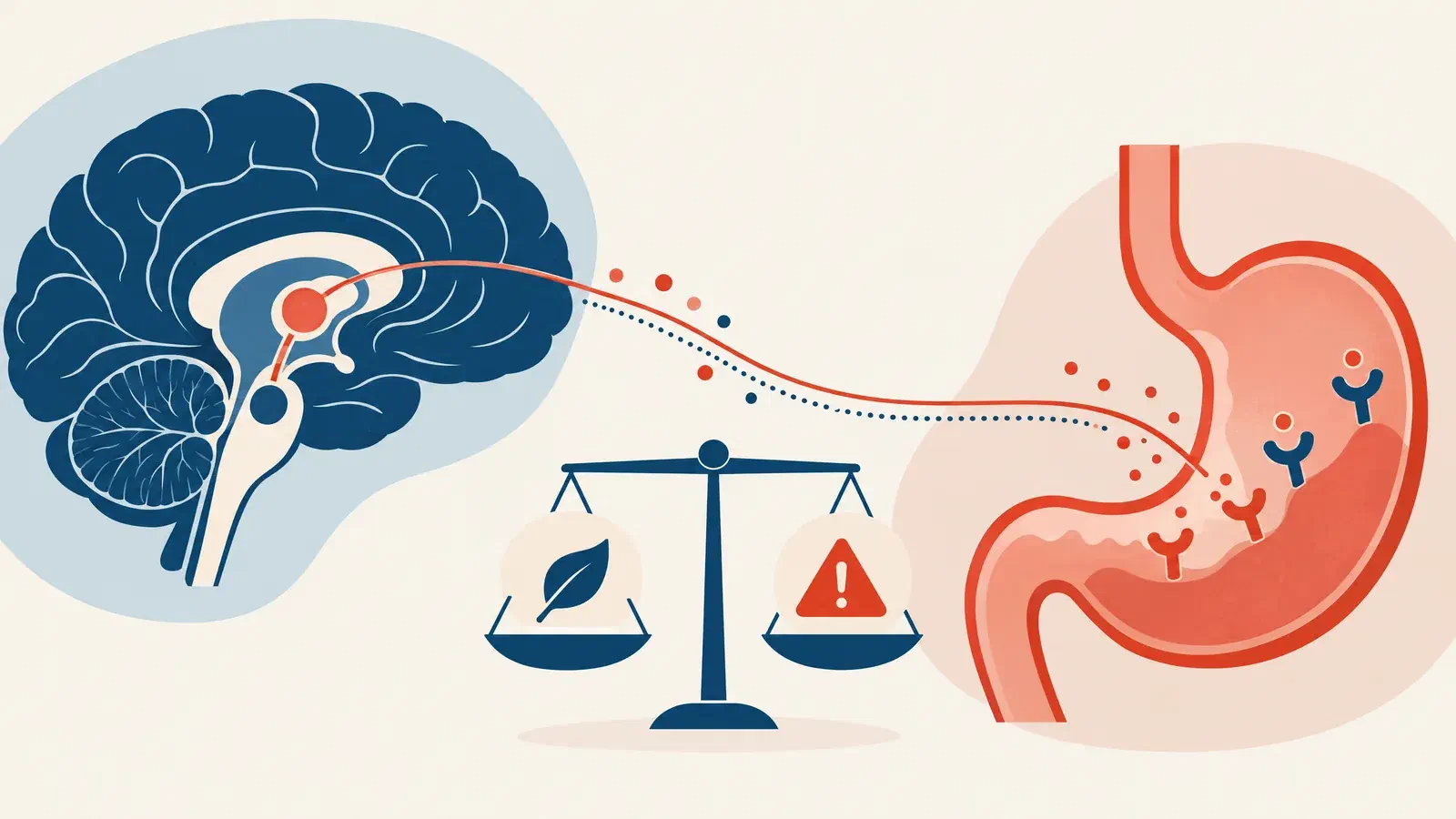
The useful distinction is between hunger, the drive to eat, and satiety, the feeling of satisfaction after eating. Medicines can influence both through brain signaling or gut-hormone pathways. A trial needs to measure what follows: weight change, tolerability and relevant health outcomes. A short hunger questionnaire can't answer all those questions.
Nor does every weight-loss drug suppress appetite. Orlistat inhibits digestive lipases and reduces dietary fat absorption; lower-dose orlistat is available without a prescription in the United States. It belongs in a different mechanism category. Tchang and colleagues' Endotext chapter, updated in 2026, describes these distinctions and the separate approval conditions for each medicine. 1
So you can ask, “What does this ingredient do, and which outcome was tested?” If the answer jumps from a laboratory receptor experiment to a promise about your weight, there's a missing piece of evidence.
Four mechanism families need different safety questions
Two treatments can reduce food intake without acting alike. A claim that a supplement works “like an injection,” for example, doesn't establish that it activates the same receptor or has comparable clinical effects. Naming the pathway helps you ask a more useful safety question.
Sympathomimetics: phentermine and related drugs
A stimulant-type medicine may reduce hunger but also disturb sleep. Phentermine increases norepinephrine signaling in appetite-regulating brain regions and has sympathomimetic effects—actions associated with the sympathetic nervous system. Possible effects include a faster pulse, higher blood pressure, dry mouth and insomnia. 1
Your cardiovascular history therefore matters. Endotext lists uncontrolled hypertension and established cardiovascular disease among contraindications. Phentermine alone has FDA approval for short-term use; the phentermine–topiramate combination has approval for long-term weight management. They aren't interchangeable labels. If longer use is proposed, you can ask how the clinician distinguishes approved use from off-label prescribing and what monitoring is planned. 1
Serotonergic drugs: lorcaserin as a historical example
“Works on serotonin” can sound like a complete explanation, yet different serotonin receptors have different effects. Lorcaserin activated the 5-HT2C receptor in appetite-regulating pathways. Williams, Nawaz and Evans described this mechanism in their 2020 Diabetes Therapy review. 2
That receptor name explains its intended action, not its overall safety. Lorcaserin, sold as Belviq, was withdrawn from the US market after FDA review of a cancer signal. It's a historical example, not a current treatment option. The Belviq withdrawal account explains the regulatory decision in more detail.
GLP-1 receptor agonists: gut signals and brain effects
Feeling full earlier after starting a medicine may prompt the question, “Is it just keeping food in my stomach?” Liraglutide and semaglutide activate the glucagon-like peptide-1 receptor. Their effects include appetite and satiety signaling in the brain; slowing gastric emptying can also contribute. Tirzepatide acts at both GLP-1 and GIP receptors, so it is a dual agonist rather than a GLP-1-only drug. 1
These treatments aren't stimulants. But gastrointestinal side effects and medicine-specific contraindications still matter. For liraglutide and semaglutide, a personal or family history of medullary thyroid carcinoma or multiple endocrine neoplasia type 2 is a contraindication. You can ask which warnings apply to the exact medicine, rather than borrowing assurances from the broader drug family. 1
CB1 blockers: rimonabant and appetite regulation
A receptor involved in food reward also has functions beyond eating. Rimonabant blocked cannabinoid type-1, or CB1, signaling, reducing appetite through the endocannabinoid system. Its weight-loss effect didn't isolate that system from mood-related harms. 2
The site's endocannabinoid-system overview provides the background. The practical question is how a proposed treatment affects people, including their mood and daily functioning—not just whether the receptor target sounds plausible.
Why were effective drugs withdrawn?
A weight-loss result can distract from an adverse-event result. Say a headline reports several kilograms lost but puts treatment discontinuations in the final paragraph. You need both before deciding what the trial means.
Christensen et al. (2007), in The Lancet, pooled four randomized trials with 4,105 participants. Rimonabant produced 4.7 kg greater weight reduction than placebo after one year. This is placebo-subtracted weight loss: the difference between the groups, rather than the treated group's total loss. 3
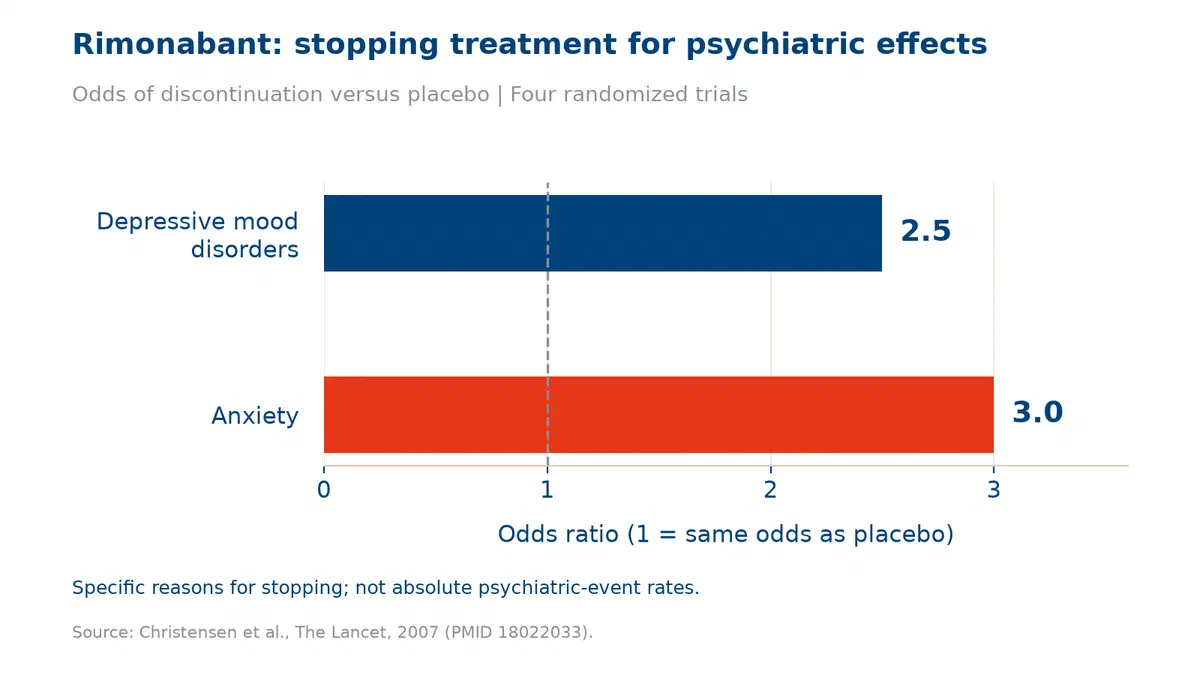
The same analysis found an odds ratio of 2.5 for stopping treatment because of depressive mood disorders and 3.0 for stopping because of anxiety, comparing rimonabant with placebo. An odds ratio compares event odds between groups. It isn't an absolute probability, and it shouldn't be relabeled as “three times your personal risk.” These outcomes concern stopping for particular symptoms, not every psychiatric diagnosis. 3
On 23 October 2008, EMA recommended suspending Acomplia's EU authorization. It reported approximately double the risk of psychiatric disorders compared with placebo and concluded that further warnings couldn't adequately manage the problem. That broader finding is separate from the discontinuation outcomes above. 4
Other drugs failed for different reasons. Sibutramine left the US market in 2010 after evidence of increased heart-attack and stroke risk. 6 A common appetite effect doesn't imply a common adverse effect. The useful lesson from the Acomplia withdrawal coverage is that efficacy alone doesn't establish an acceptable benefit–risk balance.
Lorcaserin shows why one reassuring safety result isn't enough
A trial can answer one safety question favorably while raising another. For example, reassuring cardiovascular findings don't establish that a medicine has no cancer-related concern.
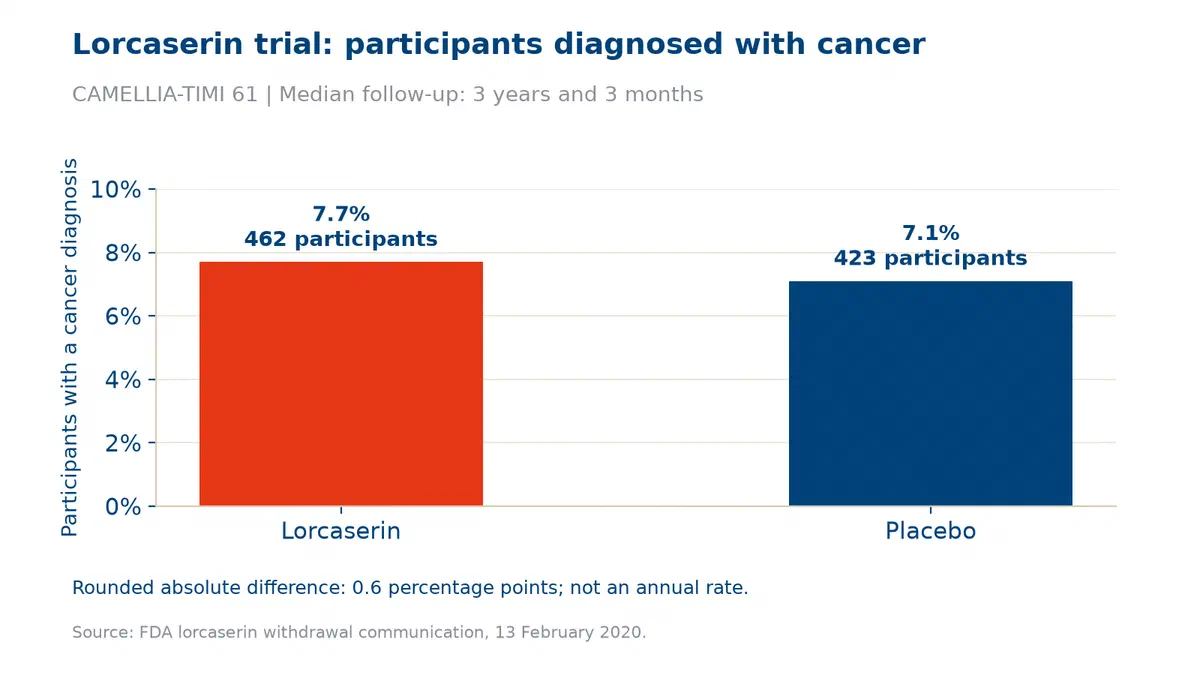
FDA's 13 February 2020 withdrawal request for lorcaserin followed its review of CAMELLIA-TIMI 61, a randomized trial involving 12,000 participants. Median follow-up was three years and three months. Cancer was diagnosed in 462 participants, or 7.7%, assigned lorcaserin, compared with 423, or 7.1%, assigned placebo. 5
Using FDA's rounded percentages, the absolute difference is 7.7% − 7.1% = 0.6 percentage points. That's a group-level comparison over follow-up, not an annual rate or a prediction for a particular person. Because the source percentages are rounded, the subtraction is an approximate difference.
FDA judged the potential cancer risk to outweigh the benefits despite the trial's reassuring primary cardiovascular safety analysis. 5 The result doesn't prove that lorcaserin caused every cancer reported. It did change the regulator's benefit–risk judgment.
If you previously took lorcaserin, FDA didn't recommend special cancer screening solely because of that exposure. Standard screening recommendations still apply; questions about your own history belong with your clinician. 5
Prescription evidence doesn't transfer to a supplement bottle
A bottle can borrow medical language without borrowing medical evidence. Say its label mentions a plant extract, a receptor pathway and “clinically tested ingredients.” That still doesn't tell you whether the finished mixture was tested in people.
Prescription medicines have defined active ingredients and approval conditions supported by evidence reviewed by regulators. Dietary supplements follow a different framework. FDA's contaminated-weight-loss-product guidance explains that manufacturers generally don't need FDA approval before selling supplements and are responsible for product safety and truthful labeling. 6 “FDA approved” is therefore not a valid blanket assurance for a dietary supplement.
Over-the-counter status also needs care. An approved nonprescription drug such as lower-dose orlistat isn't the same regulatory category as a supplement beside it on the shelf. 1 You can identify the category before comparing the claims.
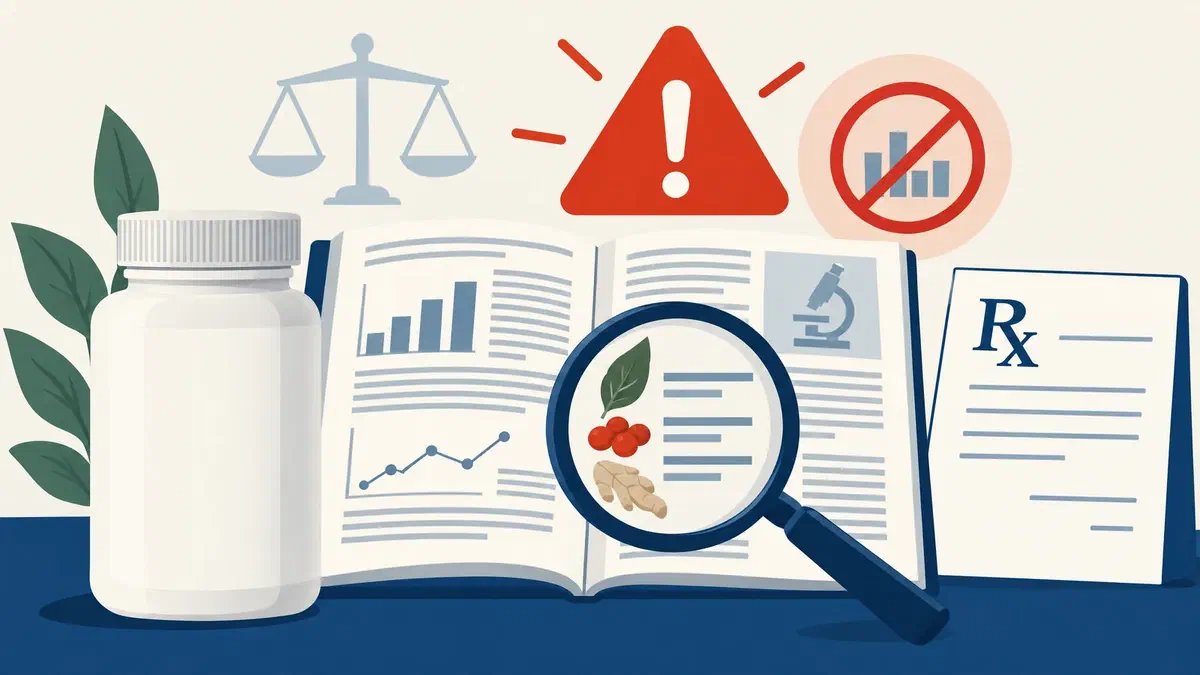
There's another problem: undisclosed drugs. FDA laboratory testing found sibutramine and rimonabant, among other pharmaceutical ingredients, in products marketed for weight loss. Its warning specifically includes rimonabant, which never received US approval. A “natural” label didn't prevent exposure to a drug with psychiatric safety concerns. 6
FDA also says it cannot test and identify every tainted product. Absence from its warning list isn't proof of safety. If a product's identity or evidence can't be established, there isn't a sound basis for treating it as equivalent to an approved medicine.
How can you check an appetite suppressant claim?
A persuasive advertisement often gives you the result first and the evidence last. For example, a before-and-after photograph may show a smaller waist while revealing nothing about the ingredient, comparison group or side effects. A useful checklist asks for information that could change your judgment.
Can you identify the exact product and ingredient? The generic drug name or complete supplement label matters more than “hunger control.” A study of one ingredient doesn't establish the effects of a different mixture. You can bring a label photograph to a pharmacist rather than relying on a remembered brand name.
What is its regulatory status here? Approved prescription drug, approved OTC drug, dietary supplement and investigational substance are different categories. The country matters, too: rimonabant's former European authorization never meant US approval. 6 A withdrawn drug isn't made acceptable by an online seller's availability claim.
Does the study match the claim? A receptor experiment supports a mechanism hypothesis; a randomized human trial can test clinical outcomes. Your questions might be, “Was this the same formulation, and did participants resemble the population in the advertisement?” Those details determine how much the evidence supports the pitch.
What happened compared with placebo, and for how long? Both groups may receive lifestyle support. Placebo-subtracted results help separate the drug's added effect from the whole program. Duration matters because a brief appetite change cannot establish sustained weight management or reveal every delayed harm.
Who stopped, and why? Discontinuation can reveal a trade-off hidden by an average weight-loss figure. Asking about sleep, mood, blood pressure and gastrointestinal symptoms connects a trial to daily life. You can also ask which contraindications or medicine interactions apply to your history. 1
What is the follow-up plan? A clinician can explain how response will be assessed and when adverse effects or inadequate benefit would prompt reassessment. A seller promising guaranteed loss or “no risk” can't replace that process; FDA identifies such promises as warning signs. 6
This checklist doesn't select treatment for you. It separates answerable medical questions from advertising that leaves the relevant facts unspecified.
Questions people ask about hunger-reducing treatments
A search box encourages a short answer to “Which is safest?” But a useful answer needs the exact medicine and the person's circumstances. These common questions are better framed around evidence than rankings.
What is the strongest medication for reducing appetite?
There's no single useful ranking of subjective hunger reduction. Weight-loss trials measure different outcomes in different populations, and greater average weight loss doesn't guarantee greater benefit for you. A clinician can compare treatments using health history, contraindications and the outcomes you want to improve. 1
Can you get weight-loss medicine over the counter?
Yes: lower-dose orlistat is an approved OTC medicine in the United States, but it reduces fat absorption rather than directly suppressing hunger. 1 A dietary supplement's nonprescription availability doesn't give it the same approval status or evidence requirements. 6
Are natural hunger-control supplements safer?
“Natural” doesn't establish safety. FDA warns about that claim and documents hidden prescription ingredients in weight-loss products. 6 You can ask a pharmacist to assess a specific label, but an incomplete label or undisclosed ingredient prevents a reliable review.
Why do people regain weight after stopping medication?
Obesity involves biological pathways that can defend body weight after weight loss. Stopping medication can remove a treatment effect and lead to regain. Endotext frames obesity pharmacotherapy as chronic-disease treatment; the expected duration and any stopping plan deserve discussion before treatment begins. 1
An unidentified ingredient is a reason to pause
An online listing may offer a dramatic promise without a clear active ingredient. For example, “prescription strength, all natural” leaves you unable to check either the supposed prescription evidence or the supplement contents.
You can't assess a treatment's benefit–risk balance if you don't know what it contains. A meaningful next step is a product label, its regulatory status and a relevant human study—not a checkout page. If those basics remain unavailable, the missing information is itself a reason to avoid treating the claim as medical evidence.
References