Blog
FDA advisory committee: How meetings and votes work

In this article
A headline says an FDA advisory committee has voted against a weight-loss drug. Does that mean the drug has been rejected? Not yet. Outside experts have given the agency advice about a particular question, using the evidence available that day. The FDA still makes the regulatory decision. You can't read the tally properly without knowing what members were asked.
The Acomplia Report, an independent rimonabant news archive, tracked the drug from its trials to its withdrawal. Its coverage of the June 2007 hearing offers a useful worked example: a unanimous recommendation against approval, driven by safety concerns rather than a claim that the drug couldn't produce weight loss.
What can an FDA advisory committee actually decide?
A webcast can look like the final stage of drug approval. Say you're watching experts raise their hands after hours of presentations. It's easy to assume those hands determine whether a prescription can be written. They don't.
FDA panels provide independent advice on scientific, technical and policy questions. The agency may ask about a new drug's benefit-risk balance, the safety of an approved product or the evidence needed for future trials. A meeting needn't end with an approval recommendation. FDA's 2013 public-hearing guidance states:
“Although advisory committees provide recommendations to FDA, FDA makes the final decisions on any matters considered by an advisory committee.” 4
The Federal Advisory Committee Act, usually called FACA, supplies the legal framework for federal advisory bodies and public access to their work. FDA's 2008 briefing-material guidance specifically connects public availability of committee documents to FACA's requirements. Some information can be withheld under Freedom of Information Act exemptions; public access doesn't mean every confidential application document becomes available. 1
For you, the useful distinction is between the committee's advice and the agency's action. Keeping them separate prevents a favorable vote from being mistaken for an approved indication. An indication is the disease or use covered by an approval. It's possible to support one use while having doubts about another, so the proposed indication belongs beside every tally you record.
Where can you find upcoming meetings and documents?
A news story may mention a hearing without linking the evidence. If you search only the drug's brand name, you may miss a notice filed under its generic name or its committee's name.
The FDA's advisory meeting calendar is the practical starting point. Each individual announcement explains the meeting's topic and anticipated format. The calendar includes past meetings too, so the date matters. A listing alone doesn't mean an event is still upcoming.
FDA's public Q&A, updated in 2024, says meeting announcements must appear in the Federal Register at least 15 calendar days before the meeting. It also says FDA intends to post background materials no later than two business days beforehand. These are different clocks. A Friday meeting doesn't imply a Sunday document release. 2
You can use the announcement to find the agenda, background materials and any webcast link. Some meetings have free webcasts, but availability isn't universal. A useful saved note contains the meeting date, time zone, committee name, product and stated question. That gives you a way to distinguish a new-drug review from a discussion of an existing drug's label.
Last-minute changes don't always reach the Federal Register quickly enough. Rechecking the individual FDA announcement before attending or watching avoids following a cancelled or postponed session. FDA names a contact person there if you need clarification. 2
How can you read briefing documents without reading every page?
Two documents can discuss the same trial and leave you with different impressions. Say the applicant's summary stresses weight loss, while FDA's review concentrates on people who stopped treatment after psychiatric symptoms. Neither summary substitutes for the underlying comparison.
A good first pass starts with the proposed indication and the questions for the committee. Next comes each document's summary, followed by the sections where the applicant and FDA disagree. Briefing packages may include material from both; their authorship matters. FDA's 2008 guidance explains how sponsor materials are prepared for public release, including the treatment of information exempt from disclosure. 1
Four checks make the reading more useful:
- Who entered the trials? Excluding people with depression can limit how confidently results apply to patients with that history.
- What counted as benefit? A lower average weight isn't the same outcome as fewer heart attacks or longer survival.
- How were harms counted? A broad psychiatric-event category differs from a specific diagnosis or a report of suicidal thoughts.
- What happened after people stopped treatment? Missing follow-up can leave uncertainty about both benefit and harm.
These checks work because they expose the gap between the studied population and the people who might receive the drug. They also help you see whether an impressive number measures something patients would experience or a laboratory marker.
Placebo-subtracted weight loss means the difference between weight loss in the drug group and the placebo group. It helps separate the drug's added effect from changes shared by both groups. But it can't settle the safety question. Our rimonabant trial overview provides context for the studies that reached the panel.

What happened at the rimonabant hearing on 13 June 2007?
Rimonabant presented a difficult trade-off: weight-loss benefits alongside concerns about psychiatric harm. A reader looking only at the weight graphs could miss why the Endocrinologic and Metabolic Drugs Advisory Committee opposed approval.
Rimonabant was sold in Europe as Acomplia; its proposed US name was Zimulti. On 13 June 2007, the committee voted 14–0 against recommending approval. All fourteen voting members opposed approval on the evidence then available. The Acomplia Report's contemporary account of the unanimous vote records the concern that a favorable risk-benefit profile hadn't been established.
The questions were more informative than the headline. Our archived preview of the FDA's draft questions separates possible causal links with psychiatric and neurological events from whether the safety profile had been adequately characterized. It then asks whether the available evidence supports a favorable risk-benefit profile and approval for weight management. These were draft questions, so they shouldn't be substituted for the final voting record.
Sam, Salem and Ghatei's 2011 review in the Journal of Obesity describes the FDA's analysis of published and unpublished trials, the psychiatric safety concerns and the fact that rimonabant was never approved in the United States. 5 Our rimonabant side-effects archive shows why these concerns featured so prominently in contemporary coverage.
The practical lesson isn't that a drug must have no adverse effects to be approved. It is that a benefit alone doesn't establish an acceptable benefit-risk balance. A negative recommendation can reflect uncertainty about harm, even when a treatment effect has been demonstrated. That's why “it works” is an incomplete answer to an approval question.
What does the voting question tell you that the tally doesn't?
A tally without its wording can reverse the meaning of a meeting. Say a panel votes yes on delaying approval until another trial reports. Describing that as a yes vote for approval would be wrong.
Your meeting note can put the question immediately above the tally, then identify what yes and no mean. If the question addresses safety alone, it shouldn't be rewritten as a decision on overall approval. Likewise, a recommendation on an additional indication doesn't cover every use of the drug.
Members' explanations reveal what a split means. Some may doubt the size of the benefit; others may accept the benefit but want more safety evidence. The same numerical margin can hide different disagreements. A unanimous vote indicates consensus among those voting, not a measured probability of harm or a guarantee of the FDA's next action.
FDA meeting minutes summarize the questions and outcomes; transcripts provide more detail. The agency's Q&A says transcripts are generally available within 90 days. 2 Until they're posted, it's reasonable to keep a provisional note rather than fill gaps with a headline. You don't need to guess what an absent member would have voted.
How often does the FDA follow panel recommendations?
“The FDA usually follows its panels” leaves a reader without a denominator or a deadline. Say a drug receives a negative recommendation but is approved years later after further work. Counting at one year and counting at final follow-up can produce different answers.
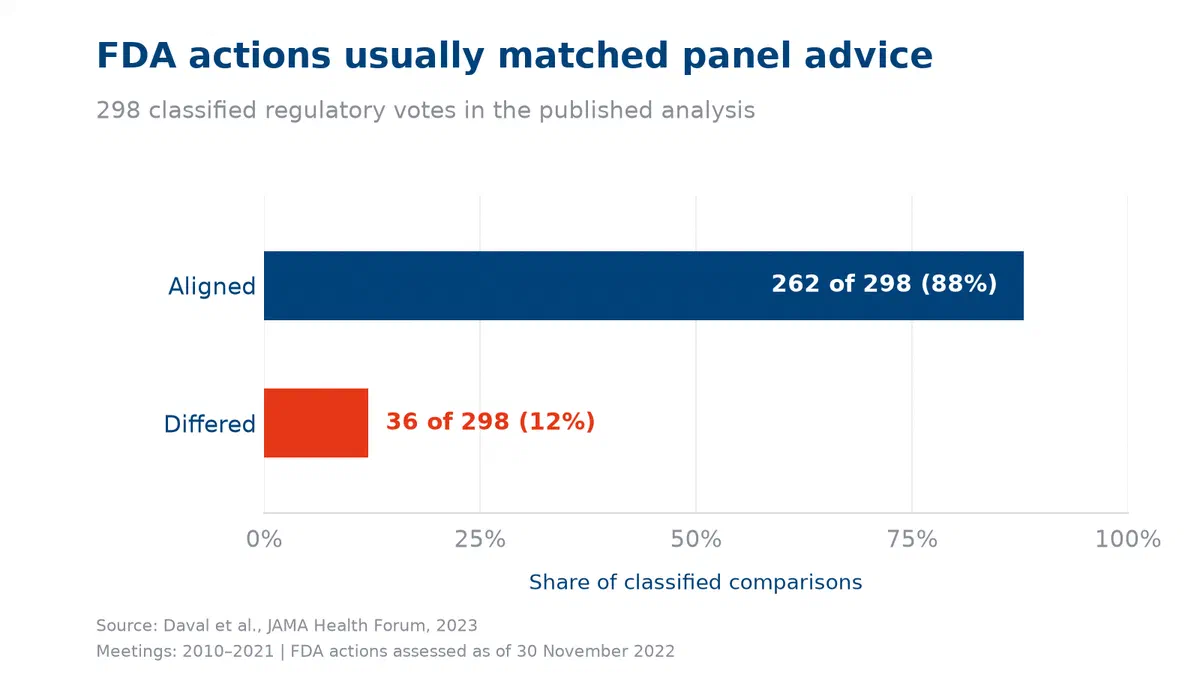
Daval et al. (2023), in JAMA Health Forum, reviewed 409 human-drug committee meetings from 2010 through 2021. After excluding ties, decisions that couldn't be classified and recommendations superseded by later votes, their main comparison included 298 votes on specified regulatory actions. FDA actions aligned with 262 of those 298 votes, or 88%, when assessed as of 30 November 2022. 6
The working is 262 ÷ 298 × 100 = 87.919463…%, rounded to 88%. The remaining 36 of 298 comparisons differed, or 12% rounded. Those percentages describe this historical sample, not every FDA meeting or the odds for a particular drug.
The direction of the recommendation mattered. Among initial-approval votes retained for that final comparison, approval followed 142 of 147 positive votes, or 97%. Nonapproval followed 40 of 60 negative votes, or 67%. 6 The second number means matching a negative recommendation by not approving; it isn't an approval rate.
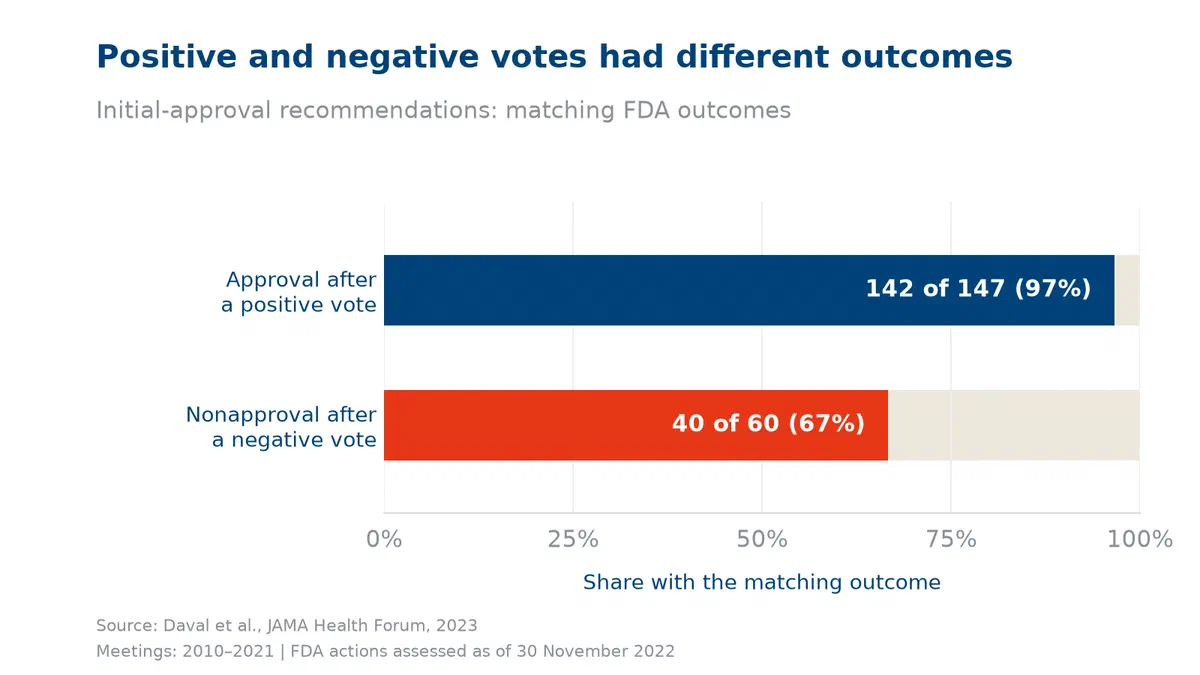
These groups had different denominators and allowed years of follow-up. The analysis describes an association, not proof that a panel caused an agency decision. You can use it to reject both extremes: votes aren't meaningless, and they aren't binding verdicts. For any current application, the later FDA action remains the document that settles its regulatory status.
Questions readers ask about panel meetings
Small procedural questions can change what you learn from a hearing. For example, watching the webcast and asking to speak are different forms of participation, with different instructions.
Can members of the public speak at an FDA panel meeting?
Yes. FDA's 2013 guidance describes an open public hearing, or OPH, where interested people can present relevant information or views orally or in writing. The rules provide at least 60 minutes for oral presentations unless public participation ends sooner. The announcement gives the contact and registration instructions. 4
Are public comments votes for or against approval?
No. Public speakers contribute information and experience; they don't cast committee votes. A personal account can explain a burden or benefit that a trial summary misses, but it doesn't establish how often an outcome occurs. Your notes can distinguish public testimony from trial data and members' recommendations.
Where are FDA panel briefing documents posted?
The individual meeting announcement and its linked materials are the best starting points. FDA intends to make background material available no later than two business days before the meeting. If it isn't available then, its Q&A explains alternative posting arrangements for onsite and virtual meetings. 2
Does a unanimous favorable vote mean a drug is approved?
No. It means the voting members agreed on the question put to them. The recommendation is nonbinding. You'd still need the FDA's approval and the approved labeling to establish the permitted use. 4
The exact question belongs beside every vote you save
A clipped headline can remain on your phone long after its context has disappeared. The rimonabant example shows what's lost when a recommendation against approval becomes a vague claim that experts disliked a drug.
One useful habit is to save the voting question, tally and evidence date together. The question defines the judgment; the date defines what evidence was available. Adding the later FDA action keeps advice separate from regulatory status. If you're discussing an approved treatment with a clinician, the current label—not an old committee headline—is the appropriate starting point for questions about its authorized use and warnings.