Blog
Fen phen: What the 1992–1997 diet-drug story teaches

In this article
A claim about a new weight-loss combination can sound reassuring: each ingredient is already familiar, and together they produce better results. The fen phen story explains why that argument isn't enough. Fenfluramine and phentermine produced substantial weight loss in a 1992 trial. By 1997, reports of unusual heart-valve disease had changed the safety judgment, and FDA requested withdrawal of fenfluramine and the related drug dexfenfluramine. 1 2 3
The Acomplia Report's independent news archive later tracked rimonabant from its trials to its 2008 market suspension. That history makes this earlier episode relevant: the recurring question is how much uncertainty you're accepting alongside a measurable benefit.
What did fen phen actually mean?
Names can hide differences that matter. Say you're looking at an old prescription record containing “phentermine” and assume it refers to the withdrawn combination. It doesn't necessarily do so.
Fen-phen meant fenfluramine plus phentermine, two appetite suppressants prescribed together. Each had an individual FDA approval, but the combination itself had no FDA approval. Fenfluramine and phentermine originally had short-term obesity indications; widespread prescribing extended fenfluramine use beyond that setting. Dexfenfluramine was a related medicine, approved separately in 1996, rather than another name for phentermine. 2 3
This distinction gives you a useful question for any combination: “Has this exact regimen been evaluated, or are we borrowing reassurance from its separate ingredients?” Familiar ingredients don't establish the safety of their joint use over a different duration.
An off-label prescription uses an approved medicine outside its approved labeling. That description doesn't prove a treatment is ineffective or inappropriate. But it tells you that the specific use lacks the same regulatory assessment as the approved indication. You can compare the proposed use with the label and ask a clinician what evidence supports the difference.
What did Weintraub's 1992 study prove?
A striking weight-loss number can lose its meaning when the comparison disappears. Imagine a headline saying participants lost 14.2 kg, without explaining what happened in the control group or what support everyone received.
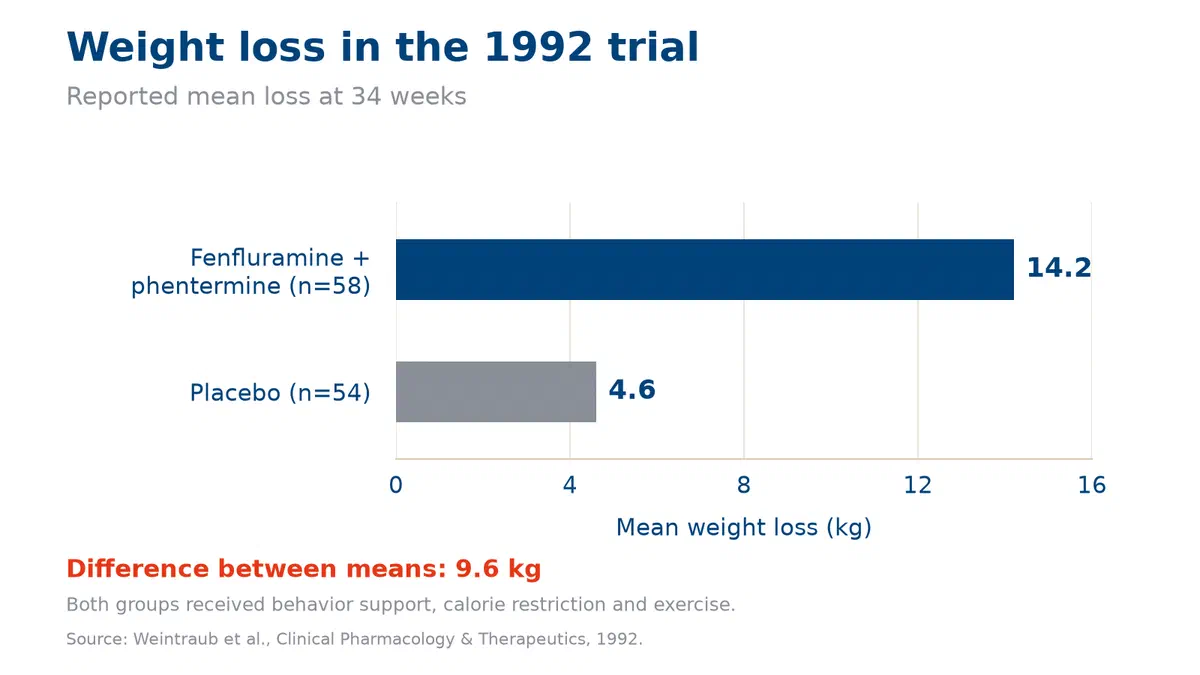
Weintraub et al. (1992), in Clinical Pharmacology & Therapeutics, enrolled 121 people in a 34-week double-blind trial. Participants received either fenfluramine plus phentermine or placebo, alongside behavior modification, calorie restriction and exercise. “Double-blind” means participants and investigators weren't told the treatment assignment. 1
By week 34, the reported mean losses were 14.2 kg in the active-treatment group and 4.6 kg in the placebo group. The figures came from 58 and 54 participants, respectively. Nine people had left the trial. 1
The placebo-subtracted weight loss—the difference between the groups—was 14.2 − 4.6 = 9.6 kg. That comparison better isolates the medication's added effect within the study program. It doesn't promise you the same result without those supports, or describe every participant's experience.
The benefit was real enough to warrant further study. The safety conclusion needed more restraint. A trial of this size and duration couldn't exclude uncommon harms or establish safety over years of use. Reassuring average blood pressure or pulse results also don't answer a separate question about valve damage.
When you read a new combination trial, the useful details are the comparator, follow-up time and number assessed at the endpoint. They tell you what the result actually supports. A longer research program shouldn't be described as continuously placebo-controlled if its design changed between phases.
How did off-label use outgrow the trial?
Popularity can masquerade as evidence. A waiting room full of people asking about a treatment may suggest that its safety questions have already been settled. They haven't.
Connolly et al. (1997), in The New England Journal of Medicine, reported that U.S. prescriptions for fenfluramine and phentermine exceeded 18 million in 1996, despite the combination's lack of FDA approval. This was a total prescription count for the drugs, not 18 million distinct patients or necessarily 18 million combined prescriptions. 2
The 1992 findings helped fuel widespread use in the early 1990s, as Rodgers, Tschöp and Wilding's peer-reviewed history (2012) describes. The public-health report also documented fenfluramine being used with phentermine and for periods longer than a few weeks. 3 5
Prescription volume can expose harms too uncommon to appear in a small trial. But volume itself doesn't supply a controlled comparison, systematic examinations or reliable follow-up. A drug can become familiar before its risks become clear.
If you're assessing a claim that “doctors have used this for years,” you can ask what was measured during those years. A registry with defined outcomes offers different evidence from a collection of satisfied patients. Experience helps most when it includes people who stopped treatment or developed problems, not just those who continued.

What did the Mayo Clinic valve reports change?
A safety signal doesn't always begin with a large trial. For example, an unexplained heart murmur in someone taking a diet drug may reveal a problem that routine weight measurements would miss.
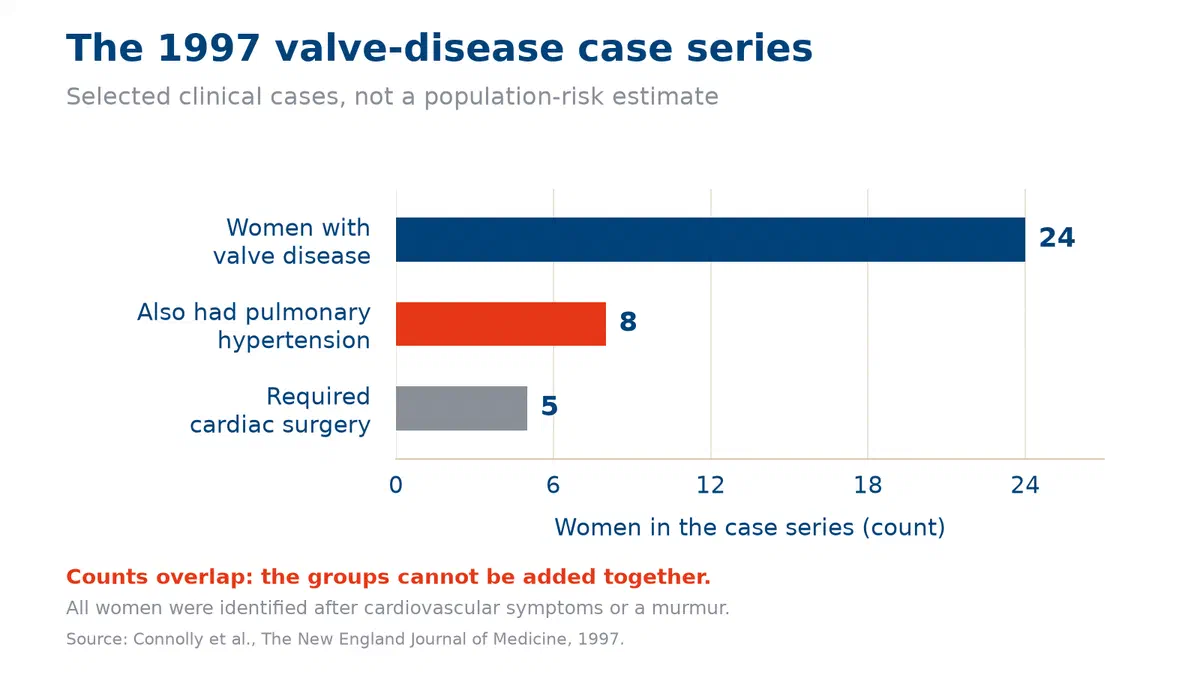
Connolly and colleagues at Mayo Clinic and collaborating clinicians identified 24 women treated with fenfluramine–phentermine who had no previous history of cardiac disease. They presented with cardiovascular symptoms or a heart murmur. Echocardiograms showed unusual valve structure and regurgitation in all 24. Regurgitation means blood leaks backward through a valve. 2
Eight women also had newly documented pulmonary hypertension, meaning raised pressure in the circulation through the lungs. Five had required cardiac surgery by the time of the report. Valve tissue had features resembling other recognized forms of drug-associated or serotonin-related valve disease. 2
The cases became public on July 8, 1997; FDA issued an advisory that day. The journal issue carrying the Connolly paper was dated August 28. Those dates aren't interchangeable. 2 3
The report raised a serious warning, but it couldn't estimate how often valve disease occurred among all users. There was no denominator covering everyone exposed, and these women had been identified because of clinical findings.
That distinction matters when you see an alarming number online. You can ask: “Is this a case count, a proportion in a screened sample, or a risk from a controlled study?” A case series can justify urgent investigation without supplying your personal probability of harm. Dismissing it because it isn't randomized would miss its purpose.
Why did FDA withdraw two drugs in September 1997?
Symptoms alone can miss damage. Someone who feels well may assume a medicine hasn't affected their heart, even when an imaging test would show an abnormality.
The joint public-health report (1997), prepared with FDA and NIH participation, described five early echocardiographic surveys of exposed patients without obvious cardiac symptoms or history. Across 284 people, 32.8% met the report's valve-disease definition. The surveys had differing methods and sampling limitations; that figure wasn't a universal risk estimate for every user. 3
These findings mattered because the concern extended beyond the original symptomatic cases. On September 15, 1997, FDA and the manufacturers announced the voluntary withdrawal of fenfluramine and dexfenfluramine from the U.S. market. FDA had requested that action based on the accumulating valve evidence. Phentermine wasn't withdrawn in that action. 3 5
It wasn't necessary to know the eventual outcome of every valve lesion before deciding the evidence justified removing the two medicines from obesity treatment. Waiting for certainty would have meant continued exposure while the uncertainties were investigated.
For a new drug, you can ask which harms require active testing rather than waiting for symptoms. That doesn't mean every weight-loss medicine needs the same heart tests. The monitoring should fit its mechanism and observed safety signals. A generic assurance that “we'll watch for side effects” leaves those details unanswered.
How did this history shape scrutiny of rimonabant?
An appealing mechanism can distract from effects outside the intended target. A medicine that changes appetite may also affect other functions of the same biological system. Rimonabant made that problem visible in a different organ system from the fenfluramine story.
Rimonabant acted on cannabinoid CB1 receptors, rather than reproducing fenfluramine's pharmacology. The archive's explanation of the endocannabinoid system provides that background. The parallel concerns the evidence standard, not a shared cause of heart-valve disease. 5
Christensen et al. (2007), in The Lancet, pooled four randomized trials involving 4,105 participants. Rimonabant produced 4.7 kg greater weight reduction than placebo after one year. But discontinuation because of depressive mood disorders was more frequent, with an odds ratio of 2.5. That statistic concerns stopping treatment for that outcome; it isn't a 2.5-fold risk estimate for every form of depression. 4
The authors also noted that depressed mood had been an exclusion criterion. A safety problem appearing even in that selected population raised questions about broader use. You can compare trial exclusions with your own circumstances before assuming its results apply to you.
The June 2007 FDA advisory hearing covered by the Acomplia Report examined psychiatric safety and whether rimonabant had a favorable benefit–risk profile. Rimonabant never received U.S. approval. 5
On October 23, 2008, EMA recommended suspending Acomplia's EU marketing authorization. It confirmed approximately doubled risk of psychiatric disorders versus placebo and judged that further risk-reduction measures wouldn't adequately address the problem. Real-world effectiveness was also lower than expected because patients often took treatment only briefly. 6
The earlier failure helps explain why weight-loss efficacy couldn't settle the later argument. It doesn't establish that fen-phen alone caused a particular regulatory decision. Rimonabant faced adverse evidence of its own, as the archive's report on the European suspension documents.
Questions readers ask about fenfluramine and phentermine
Old drug names leave practical uncertainties. If a family member remembers a prescription but not its ingredients, these distinctions are more useful than treating every appetite suppressant as the same medicine.
Was the combination FDA approved?
No. The individual drugs had approvals, but fen phen as a combination did not. Connolly et al. explicitly stated that distinction in 1997. You can ask the same question about a proposed regimen: approval of its ingredients isn't approval of their joint use. 2
Was phentermine banned in 1997?
No. The withdrawal concerned fenfluramine and dexfenfluramine, not phentermine. That doesn't make every phentermine-containing regimen suitable for everyone; its own labeling and the evidence for the exact combination still matter. 3 5
Did everyone who took the drugs develop valve disease?
No. The original report described selected cases, and subsequent surveys found abnormalities in some exposed patients. Neither establishes that every user developed disease. A clinician can help interpret past exposure alongside your history and any prior heart assessments. 2 3
What if I took the combination years ago?
An old prescription record can help identify the actual drugs and exposure period. You can share it with your clinician and ask whether your current history warrants further assessment. The public-health recommendations cited here were issued in 1997; they're historical evidence, not a substitute for today's individualized evaluation. 3
A new combination needs its own safety evidence
A claim can fail at the point where it sounds most reassuring. “Both ingredients are approved” doesn't answer whether combining them changes the balance between benefit and harm.
Say you bring a printed trial abstract to an appointment. A useful question is: “What evidence supports this exact combination for the length of time I'd be expected to use it?” The answer should identify the regimen studied, who was included and how adverse outcomes were sought—not just the mean weight loss.
You can also ask what new evidence would change the plan. That question makes uncertainty concrete: a concerning symptom, a test result or a regulator's warning may matter differently for different medicines.
The fenfluramine episode argues for evidence that keeps pace with exposure, rather than confidence borrowed from popularity. Rimonabant shows why that standard remains relevant even when a new mechanism produces measurable benefit. The most useful reassurance is a specific explanation of what has been checked, over what period, and what remains unknown.
Sources