Blog
Inverse agonist: what rimonabant teaches about receptors

In this article
An inverse agonist binds to a receptor and reduces its background activity, even when no activating chemical is present. A neutral antagonist can block an activating chemical without lowering that background activity. The difference sounds small. For rimonabant, the withdrawn weight-loss drug, it became a serious research question: could suppressing background CB1 signaling help explain some psychiatric effects?
The Acomplia Report is the independent news archive that followed rimonabant from its trials through its 2008 withdrawal. Its history makes this distinction useful: you can understand what a drug does at a receptor without assuming that the mechanism alone explains every benefit or harm.
How does an inverse agonist differ from an antagonist?
A paper calls a medicine a “blocker,” but you can't tell what it blocks. Say you've left a kitchen radio playing quietly while you make coffee. Someone can turn it up, prevent another person from turning it up, or turn it down below its starting volume. Those are different actions.
An agonist is like turning the dial up. It binds to a receptor and increases receptor activity. A full agonist can produce the maximum response available in the test system; a partial agonist produces less under the same conditions. Partial doesn't mean harmless. It describes a response, not a safety grade.
A neutral antagonist is like a guard preventing someone from turning the dial. In a test without an activating chemical, it doesn't raise or lower constitutive receptor activity. At a shared binding site, it can compete with an agonist and reduce the agonist's effect.
A drug with inverse activity is like turning down the radio's existing volume. It binds to the receptor and reduces activity that the receptor generates without an agonist. It can also compete with an agonist. Berg and Clarke's 2018 pharmacology review explains this distinction through receptor states and their effects on signaling. 1
The radio has limits as an analogy. A receptor isn't a knob with a single output, and increasing receptor activity doesn't always increase the laboratory measurement. Some receptors activate pathways that inhibit other processes. Your useful question is: “What activity did the researchers measure, and relative to what starting level?”
Why is a receptor doing anything without an agonist?
A graph starts above zero before researchers add a drug. You might think the cells are contaminated, or that the receptor must already have an activating chemical attached. Neither explanation is automatic.
Constitutive activity means receptor signaling without an activating ligand. A ligand is a molecule that binds to a receptor. Receptor proteins can change shape spontaneously, and some shapes can engage the cell's signaling machinery. In a simplified model, receptors shift between active and inactive states; different drugs favor different parts of that balance. 1
But background signaling has another possible source. The body makes its own activating molecules, called endogenous agonists. Their ongoing effects are sometimes called agonist tone. That isn't the same as constitutive activity, although both can produce a signal before an experimental drug is added.
This matters when you read a claim such as “the blocker reduced baseline signaling.” A neutral blocker can reduce an existing signal by preventing an endogenous agonist from acting. That result alone doesn't demonstrate suppression of ligand-independent activity. Berg and Clarke (2018) specifically warn against confusing those explanations. 1
You can look for experiments that account for endogenous agonists and establish a measurable constitutive signal. It also helps to check whether the cells naturally expressed the receptor or were engineered to express it abundantly. Receptor density and the cell's signaling machinery affect the observed response. A clear laboratory result doesn't establish how much background activity exists in a patient's brain.
What did rimonabant do at CB1 receptors?
An older article calls rimonabant a CB1 antagonist; another calls it an inverse agonist. You don't necessarily have a contradiction. The first term can describe blocking cannabinoid-induced activation, while the second describes its additional ability to suppress constitutive signaling.
Rimonabant, also identified in research as SR141716A, has inverse activity at the cannabinoid type 1 receptor, or CB1. Tam et al. (2010) found that it reduced a measure of G-protein activation in mouse brain membranes, whereas the neutral compound AM6545 did not. That functional comparison distinguishes the drugs more clearly than the word “blocker” does. 5
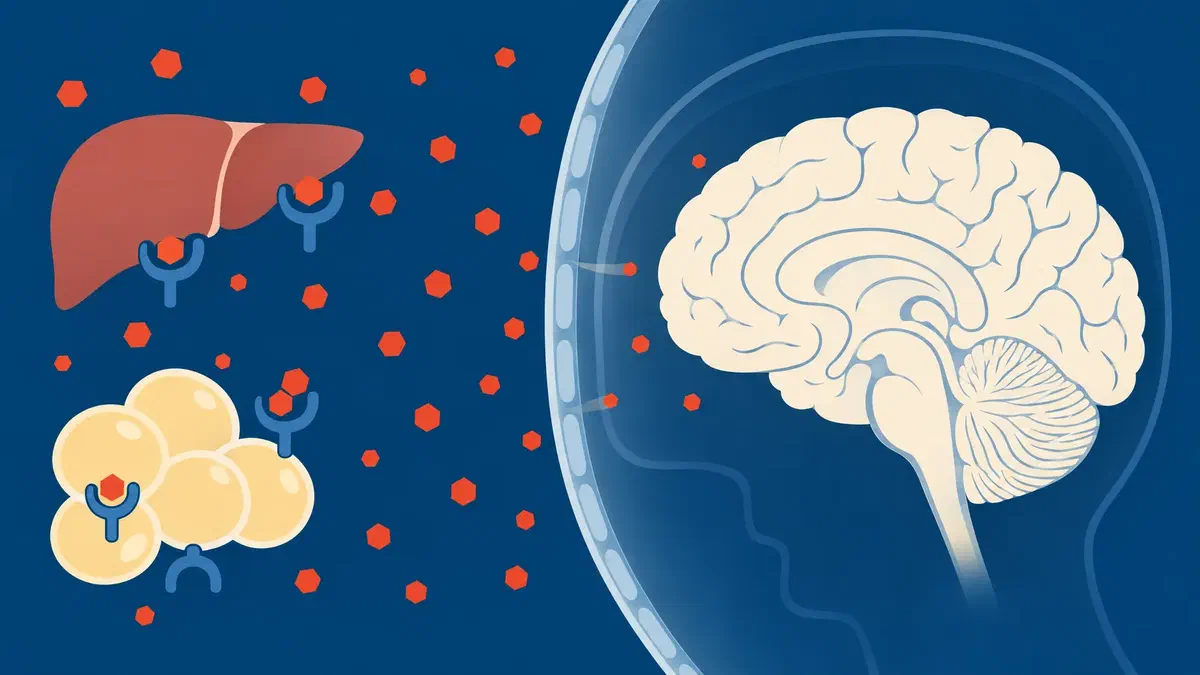
CB1 belongs to the G-protein-coupled receptor family. These receptors communicate with signaling proteins inside cells. CB1 is present in the brain and in peripheral tissues, including the liver and fat. Its involvement in appetite and metabolism helped make it an attractive obesity-drug target. The site's endocannabinoid system background explains that wider context.
Rimonabant also enters the brain. That's relevant because CB1 participates in circuits connected with mood, anxiety and reward, as Tam and colleagues discuss. 5 Reducing appetite and altering emotional responses can therefore involve the same receptor family in different locations.
When you're comparing descriptions, “selective CB1 blocker” answers which receptor the drug prefers. It doesn't tell you whether the compound suppresses constitutive activity or where it reaches that receptor. Selectivity isn't a promise of psychiatric safety.
Did inverse agonism cause rimonabant's psychiatric effects?
You read that rimonabant increased psychiatric problems, followed by an explanation blaming its inverse activity. It's tempting to treat those statements as equally established. They're different kinds of evidence.
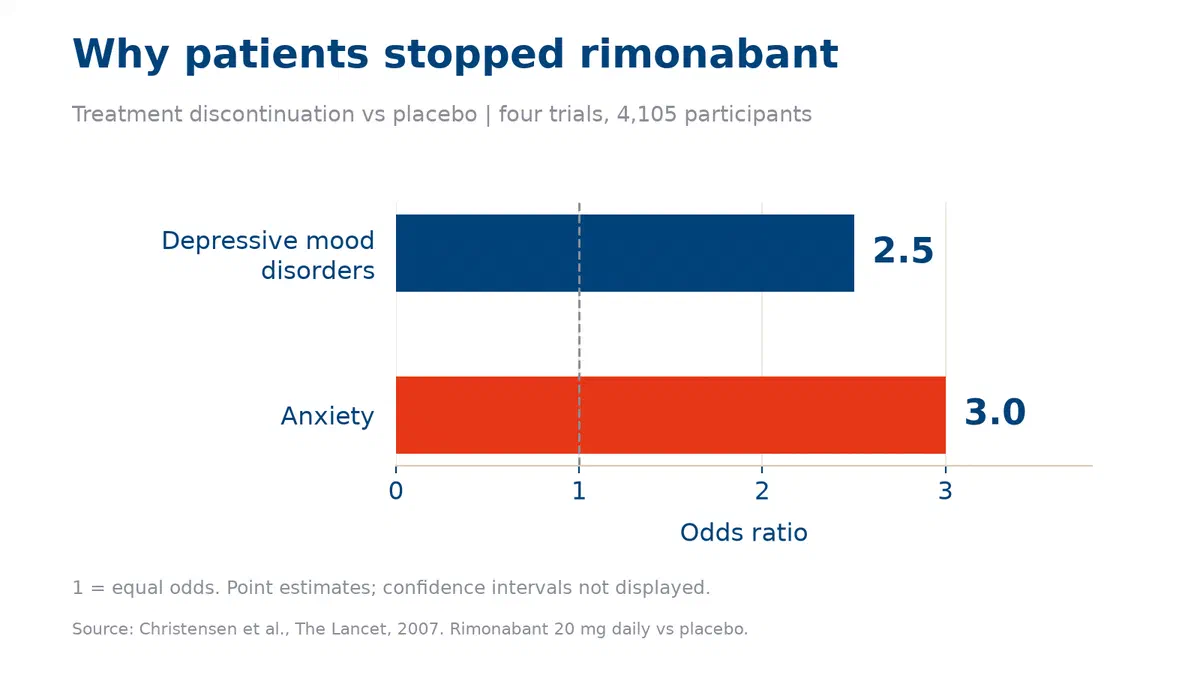
Christensen et al. (2007), in The Lancet, pooled four randomized trials involving 4,105 participants comparing rimonabant 20 mg daily with placebo. The odds ratio for stopping treatment because of depressive mood disorders was 2.5; for stopping because of anxiety, it was 3.0. Those are trial comparisons, not dosing recommendations. 2
An odds ratio compares the odds of an event between groups. A value of 1 means equal odds. These figures don't mean that 2.5% or 3.0% of participants developed symptoms, and they don't give an individual's probability. They specifically describe treatment discontinuation for those reasons, rather than every episode of anxiety or depression.
On 23 October 2008, the European Medicines Agency recommended suspending Acomplia's authorization. It reported an approximate doubling of psychiatric disorders compared with placebo and concluded that further risk-reduction measures couldn't adequately address the problem. 3 The Report's coverage of the European market withdrawal records that turning point.
The EMA stated:
“the benefits of Acomplia no longer outweigh its risks” 3
Inverse activity offers a plausible contributor: suppressing ligand-independent CB1 signaling could disturb functions involved in emotional regulation. Gueye et al. (2016) discussed that explanation alongside experiments with a neutral blocker. 4 But rimonabant also blocks endogenous cannabinoid signaling in the brain. Clinical comparisons with placebo don't isolate those actions.
So the sound position is narrower than “inverse activity caused the withdrawal.” Psychiatric harm was documented; the contribution of constitutive-signal suppression remains a mechanistic hypothesis. A proposed explanation shouldn't weaken the safety finding, and the safety finding shouldn't be presented as proof of that explanation.
Why did researchers pursue neutral and peripheral blockers?
A research headline promises “CB1 blockade without the brain effects.” You need to know what changed. Did the new compound behave differently at the receptor, enter the brain less readily, or both?
Neutral antagonism changes receptor behavior. The aim is to block agonist-driven signaling while leaving ligand-independent activity intact. Gueye et al. (2016) tested the neutral CB1 compound AM4113 in rats. After chronic treatment, it did not produce the anxiety-like effects observed with rimonabant in their plus-shaped maze test, a behavioral assay using open and enclosed arms. 4
That supports further research, but it isn't a human safety result. A rat's behavior in a maze doesn't diagnose depression or predict every psychiatric response. Nor does neutral activity leave the entire endocannabinoid system untouched: it still blocks endogenous agonists. You can't assume “neutral” means emotionally neutral.
Peripheral restriction changes drug exposure. The aim is to reach CB1 outside the brain while limiting access to brain receptors. Think of maintenance work in a building's ground-floor rooms while access to the control room remains limited. The drug still has a target; its distribution changes.
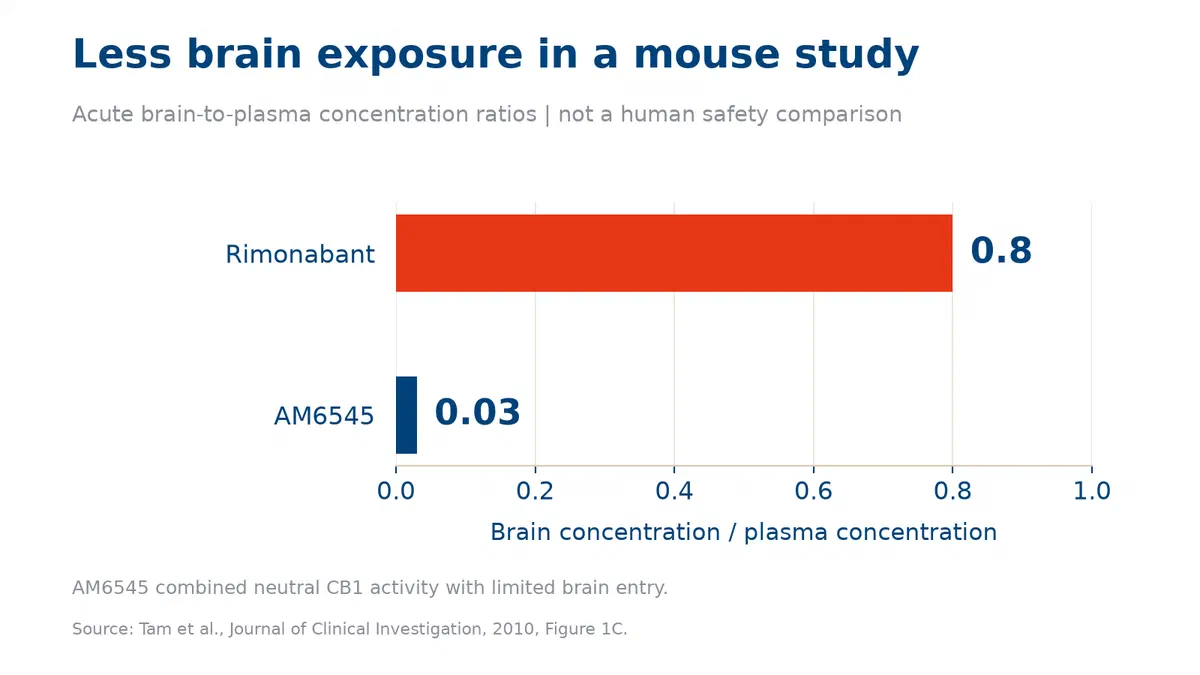
Tam et al. (2010), in the Journal of Clinical Investigation, studied AM6545, which combined neutral activity with limited brain entry. In their acute mouse exposure comparison, its brain-to-plasma concentration ratio was 0.03, versus 0.8 for rimonabant. The researchers measured this after dosing and removal of intravascular fluids. A lower ratio indicates less brain concentration relative to plasma concentration. 5
AM6545 improved glucose regulation, fatty liver and the plasma lipid profile in the mouse models. Some improvements occurred independently of weight loss. 5 That gave researchers a reason to pursue peripheral CB1 targets, rather than assuming every metabolic benefit required brain exposure.
The distinction helps you judge newer compounds. “Peripherally restricted” doesn't establish zero brain entry at every exposure, and a low mouse ratio doesn't establish clinical safety. You'd still want human exposure data and direct psychiatric-event monitoring. The archive's early report on peripheral CB1 research shows how long this question has been under investigation.
How can you read the mechanism section of a label or paper?
A label offers one sentence about receptor blockade; a paper offers several pages of binding results. Neither gives you an immediate answer about what a patient experiences. You can separate the evidence into questions that have different jobs.
What binds where? Affinity describes binding to a receptor. Values such as Ki or Kd concern binding strength under stated experimental conditions. A binding experiment alone doesn't establish whether receptor activity rises, falls or stays unchanged. You'd need a functional assay, meaning an experiment that measures a response. 1
What changed from baseline? The functional result should identify the starting condition, activating ligand and measured pathway. If the experiment only shows blockade of an added agonist, you haven't yet distinguished neutral antagonism from negative efficacy. A second assay examining constitutive activity can help resolve that gap.
Where was the drug measured? Brain exposure, peripheral exposure and receptor selectivity are separate properties. The AM6545 example shows why distribution measurements matter alongside receptor assays. But tissue concentration ratios and receptor occupancy aren't interchangeable measurements.
What happened in people? Adverse-event definitions, comparison groups and follow-up determine what a safety claim means. “No psychiatric signal” needs a study population and a monitoring method before you can interpret it. A mechanism diagram can't supply those missing details.
For historical context, the site's archived Acomplia product characteristics let you compare a label's wording with research descriptions. They're historical material, not current prescribing guidance. Useful questions for a pharmacist or clinician include: “Does this term describe binding or function?” and “Is this safety claim based on patients, animals or cells?”
Frequently asked questions about receptor blockers
A search result often gives you a one-line definition, such as “antagonists switch receptors off.” That shortcut can erase the distinction you've just learned. These questions help you test it.
Is an inverse agonist the same as an antagonist?
No. Both can block an agonist's effect, but negative efficacy also means reducing constitutive receptor activity. A neutral antagonist leaves that ligand-independent activity unchanged in a suitable assay. If the experimental system has little measurable constitutive activity, the two can appear similar. 1
Does inverse agonism mean a drug is dangerous?
No. It describes receptor action, not a universal safety category. The receptor, tissue, exposure and clinical evidence matter. Rimonabant's documented psychiatric risks don't establish the same risks for every drug with negative efficacy at a different receptor.
Are neutral CB1 antagonists proven safer than rimonabant?
The animal comparisons cited here support testing that possibility; they don't prove human psychiatric safety. A clinical claim would need direct human evidence. You'd also want to know whether reduced brain exposure, rather than neutral activity alone, helped explain any difference.
A mechanism label cannot replace a psychiatric safety assessment
Suppose a future paper describes a compound as “neutral” or “peripheral” and leaves you wondering whether those words settle the rimonabant question. They don't. They identify testable properties that may change the benefit-risk balance.
Your next useful check is the human safety evidence: who was studied, how mood symptoms were assessed, and what happened against a comparison group. That works because it tests the outcome you care about, rather than substituting a receptor description for it. For a CB1 drug, the question to bring to a clinician is specific: “What psychiatric monitoring did the trial use, and what did it find?”
References