Blog
Sibutramine (Meridia): SCOUT, withdrawal and hidden drugs
In this article
A bottle of “herbal slimming” capsules can look unrelated to a prescription drug withdrawn years ago. That distinction isn't reliable. Sibutramine, once sold as Meridia in the United States and Reductil in Europe, helped people lose weight but raised cardiovascular safety concerns. Regulators acted in 2010. FDA laboratories have since found the withdrawn ingredient hidden in products sold for weight loss.
The Acomplia Report is an independent news archive that tracked rimonabant through its trials and withdrawal, while also covering other diet drugs. Our 2004 report on Meridia safety concerns recorded questions about blood pressure and heart rate well before the decisive outcomes trial. That history helps explain why a smaller waistline isn't enough evidence that a drug improves health.
How did sibutramine work?
The word “slimming” doesn't tell you what a product does. Say you find an old Reductil leaflet while helping a parent sort a medicine cupboard: its appetite effect came from brain chemistry, not from blocking fat absorption.
The European Medicines Agency's 2010 review describes the medicine as a serotonin–noradrenaline reuptake inhibitor. It prevented these chemical messengers from being taken back into brain nerve cells, increasing their availability. That helped people feel full after meals and reduced food intake. Noradrenaline is also called norepinephrine. 2
The same medicine could increase heart rate and blood pressure. Its effects weren't confined to hunger. You can assess an appetite claim more usefully by asking which biological pathway it affects and what else that pathway controls. The site's overview of other diet drugs provides historical context for medicines with different targets.
Meridia wasn't rimonabant. The latter acted on CB1 receptors in the endocannabinoid system. A shared purpose—weight reduction—doesn't mean shared mechanisms or identical risks.
EMA found average weight loss of two to four kilograms more than placebo across the studies it reviewed. That's placebo-subtracted weight loss: the difference between the drug and comparison groups, rather than every kilogram lost by drug-treated participants. The distinction matters because diet, activity changes and trial support can also affect weight. 2
What did the SCOUT trial actually test?
A short trial can record weight loss without answering what happens to the heart later. For example, a favorable weight measurement at a follow-up visit doesn't tell you whether years of treatment reduce strokes.
James et al. (2010), in the New England Journal of Medicine, addressed that larger question in SCOUT, the cardiovascular outcomes trial. They enrolled 10,744 adults aged 55 or older with overweight or obesity and pre-existing cardiovascular disease, type 2 diabetes, or both. After a six-week lead-in period, 9,804 participants were randomized: 4,906 to active treatment and 4,898 to placebo. Mean treatment duration was 3.4 years. Scheen's 2011 review discusses the trial and its implications. 1
Everyone received the medicine during the lead-in, alongside a weight-management program. The randomized comparison therefore tested continued treatment against switching to placebo after initial exposure. It wasn't a comparison between people who had never received the drug and people starting it.
The primary endpoint was the first occurrence of nonfatal heart attack, nonfatal stroke, resuscitation after cardiac arrest, or cardiovascular death. This is a composite endpoint: several outcomes grouped into one measure.
You can judge that measure by looking at its components. A composite can increase because of nonfatal events even when death rates don't increase. That isn't a contradiction, and it doesn't make the nonfatal events trivial.
How big was the cardiovascular difference?
“Sixteen percent higher risk” can sound like sixteen extra people harmed out of every hundred. It doesn't mean that. The trial reported both event percentages and a time-to-event measure, and they answer different questions.
James et al. reported a primary-event rate of 11.4% with active treatment versus 10.0% with placebo. Nonfatal heart attacks occurred in 4.1% versus 3.2%; nonfatal strokes occurred in 2.6% versus 1.9%. The trial didn't find increased rates of cardiovascular death or death from any cause. 1
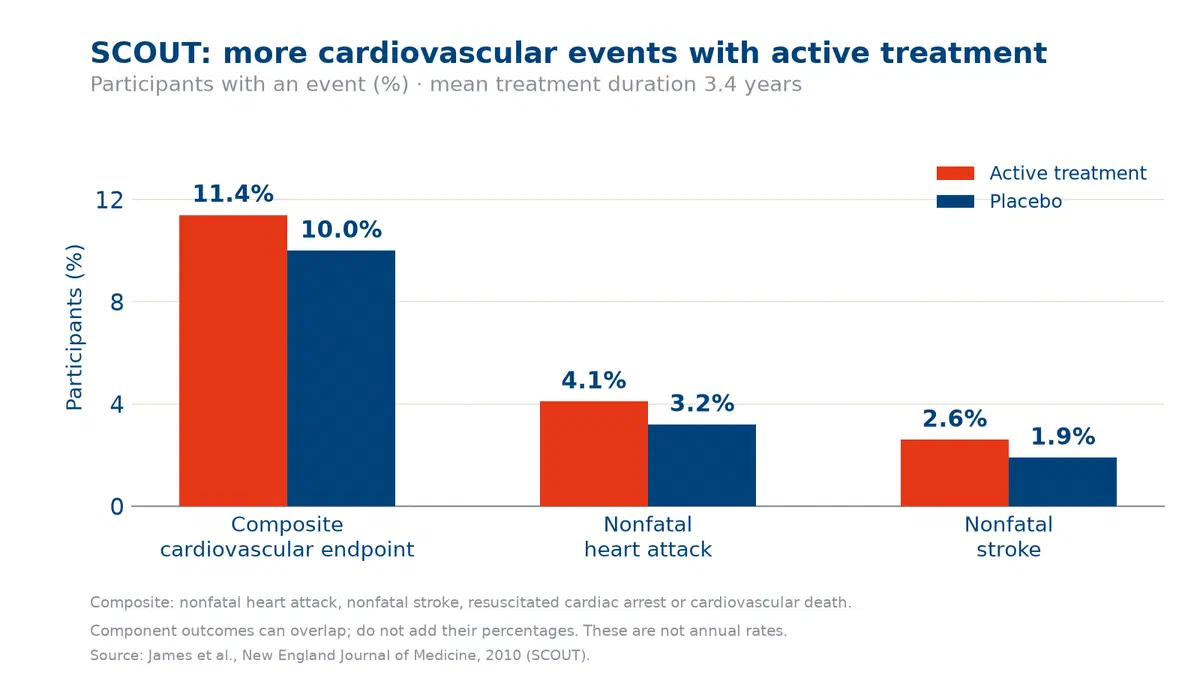
The absolute difference for the composite was 11.4% − 10.0% = 1.4 percentage points. Expressed per 1,000 comparable participants, that's 114 − 100 = 14 additional people with an event over the trial's observed treatment period. It isn't an annual rate or a prediction for a younger person taking an unknown supplement.
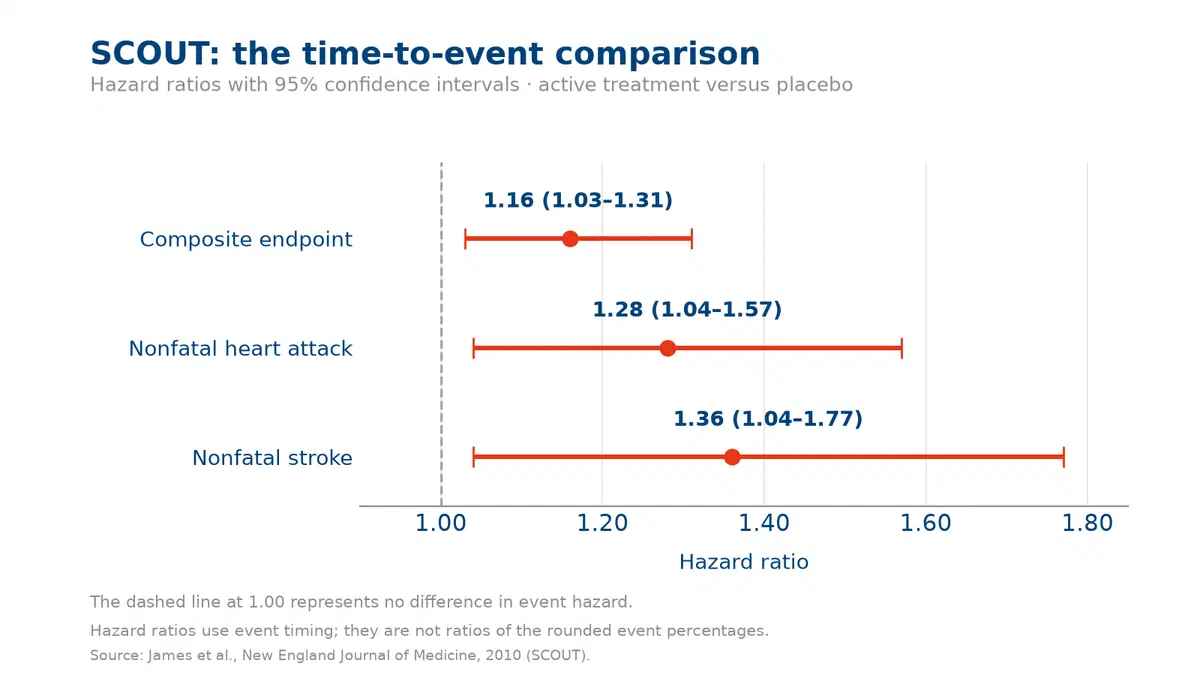
The hazard ratio was 1.16, with a 95% confidence interval of 1.03–1.31. A hazard ratio compares how quickly events occur over time. Here, it indicated a 16% higher event hazard. Dividing the rounded event percentages gives a different result: (11.4 ÷ 10.0 − 1) × 100 = 14%. That crude relative increase ignores event timing, so it shouldn't replace the published hazard ratio.
For nonfatal heart attack, the hazard ratio was 1.28 (95% CI 1.04–1.57). For nonfatal stroke, it was 1.36 (1.04–1.77). Each interval excluded 1.00, the value representing no difference in hazard. 1
If you're comparing a headline with a trial abstract, the number-needed-to-treat guide explains why the absolute difference and observation period belong together. A relative figure alone can't tell you how many people experienced harm.
Why did Europe suspend it and the US withdraw it?
Old drug references can leave you unsure which action happened when. A January European recommendation and an October American withdrawal weren't the same event.
On January 21, 2010, EMA's Committee for Medicinal Products for Human Use recommended suspending marketing authorizations across the European Union. The European Commission issued its decision on August 6, 2010. EMA concluded that the modest weight-loss benefit didn't outweigh the cardiovascular risks. 2
There was a real debate about the trial population. Most SCOUT participants wouldn't normally have received the medicine under its prescribing restrictions because they had cardiovascular disease. EMA acknowledged this, but judged the findings relevant to practice because people with obesity or overweight are themselves likely to have cardiovascular risk. 2
So the trial doesn't establish an identical risk increase for every possible patient. But that limitation didn't identify a reliably safe group whose benefits clearly outweighed harm. The regulator required evidence of such a group before a suspension could be lifted.
On October 8, 2010, FDA recommended against continued prescribing and use. It requested voluntary withdrawal, and Abbott agreed to stop US marketing. Wikipedia's regulatory history records the dated action; Scheen (2011) also describes the October withdrawal. 3 1
When you encounter an old efficacy claim, its date matters. An earlier approval or favorable weight-loss result doesn't cancel a later safety decision. The European and US actions weren't announcements that the medicine had stopped reducing weight; they were judgments about whether that benefit justified its risks.
How does a withdrawn drug end up in supplements?
An ingredient list can be misleading precisely because the risky ingredient is absent. A leaf on a bottle won't reveal an undeclared pharmaceutical.
FDA's October 2, 2024 notification about Body Shape Weight Loss System provides a concrete example. Laboratory analysis found sibutramine and phenolphthalein, neither listed on the label. An earlier notice about the same product name appeared on November 24, 2020. These are documented findings, not a claim about every product with a similar name. 5
FDA warns that the concealed appetite suppressant can substantially increase blood pressure or heart rate in some people and can interact with other medicines in life-threatening ways. The absence of a declared drug also prevents you or a pharmacist from checking the actual exposure against your medication list. 5
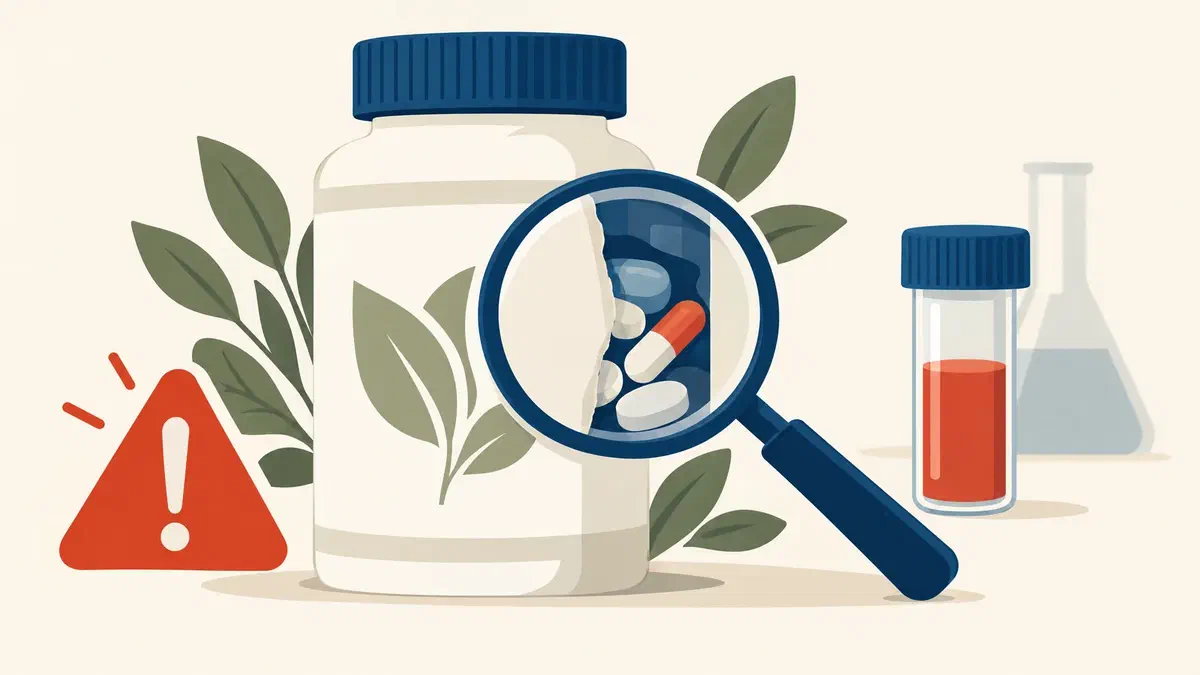
Ordinary supplements generally don't receive FDA approval before sale. Their manufacturers are responsible for safety and truthful labeling. A product containing an undeclared prescription drug isn't made legitimate by calling it a dietary supplement. 4
This is why a testimonial saying “it worked immediately” isn't reassuring evidence. Noticeable appetite suppression could have several explanations; you can't identify the ingredient from the effect. The appropriate response is an evidence check, not a home experiment.
What can you check before taking a weight-loss supplement?
A search that returns no warning can create false reassurance. Say you're standing in a store with a bottle whose name is almost, but not quite, the name in an FDA notice. Product identity matters, and a search result isn't a chemical test.
You can use the FDA Weight Loss Product Notifications database to look for the exact product name and recognizable spelling variants. Opening the notice lets you compare its photograph and any manufacturer, distributor or packaging details with the bottle. A matching name is a reason to investigate; a different spelling isn't a clean bill of health.
FDA states the limit directly:
“If a product is not on the list, that does not mean it is safe.” 6
The agency can't test every product. A warning list records detected problems, rather than certifying everything else. Several checks can reduce avoidable uncertainty:
- Product identification: Photos of the front label, ingredient panel, lot number and expiry date, if present, help a pharmacist or regulator distinguish one bottle from another. The receipt or order record adds seller information.
- Claim checking: “All natural,” dramatic before-and-after photographs and promises of easy weight loss don't establish safety. FDA identifies natural-safety claims and undocumented testimonials as warning signs of health fraud. 4
- Medication review: A clinician or pharmacist can compare the declared ingredients with your prescriptions and health conditions. Bringing the actual package is more useful than remembering “a herbal capsule.” Hidden ingredients still prevent a complete interaction check. 4 5
- Evidence checking: A seller's claim that a product was “tested” needs detail: which laboratory, which substances, which batch? A test for bacteria or heavy metals doesn't answer whether an appetite suppressant is present.
None of these checks proves a bottle is drug-free. Identifying concealed pharmaceuticals requires appropriate laboratory analysis; smell, color and a readable label won't do it. You don't need to take a suspect product to find out whether its claims are true.
Frequently asked questions about Meridia and hidden drugs
Search results often mix old prescription information with current supplement warnings. A page describing a once-approved medicine can therefore answer the wrong question about a bottle offered today.
Is sibutramine still approved in the United States?
Meridia was withdrawn from the US market in 2010 after FDA requested voluntary withdrawal over cardiovascular risk. An old prescription leaflet doesn't establish present availability. A supplement containing the ingredient isn't an approved substitute. 1 3 4
Are Meridia and Reductil the same drug?
They were trade names for the same active medicine, used in different markets. If you encounter either name in an old trial or safety notice, the underlying cardiovascular concerns refer to that compound. 2 3
Does a missing FDA warning mean a supplement is safe?
No. An unsuccessful search means you haven't found a listed warning, not that FDA tested the product and found no hidden drug. The database covers only a fraction of contaminated products. 6
Can I test a capsule for hidden drugs at home?
Appearance and a taste test can't identify pharmaceutical ingredients. FDA's documented findings came from laboratory analysis. Taking a capsule to judge its effect creates exposure without answering what it contains or how much is present. 5
A suspected reaction needs a product record, not another dose
Symptoms can be dismissed as evidence that a “fat burner” is working. For example, new palpitations after an unverified capsule shouldn't be treated as proof of a successful metabolism claim.
FDA's warning directs consumers and health professionals to report adverse events through MedWatch. Its notification page provides the reporting route. A report can include the product name, photographs, lot details, timing and other medicines taken; that information gives investigators something specific to examine. You don't need a laboratory result before reporting a suspected reaction. 5
Chest pain or possible stroke symptoms call for emergency medical care, not a database search. For other suspected reactions, prompt contact with a health professional allows assessment without assuming a particular hidden ingredient caused them. Keeping the package and purchase record can help that assessment. The useful evidence is the identifiable bottle and what happened after exposure—not whether another capsule produces the same result.
References
Primary trial for the event percentages, enrollment figures and both charts: James WP et al. “Effect of sibutramine on cardiovascular outcomes in overweight and obese subjects.” New England Journal of Medicine. 2010;363:905–917. DOI: 10.1056/NEJMoa1003114. PMID: 20818901. The linked Scheen review discusses this trial. 1