Blog
Monlunabant: CB1 blockade returns, with old safety questions
In this article
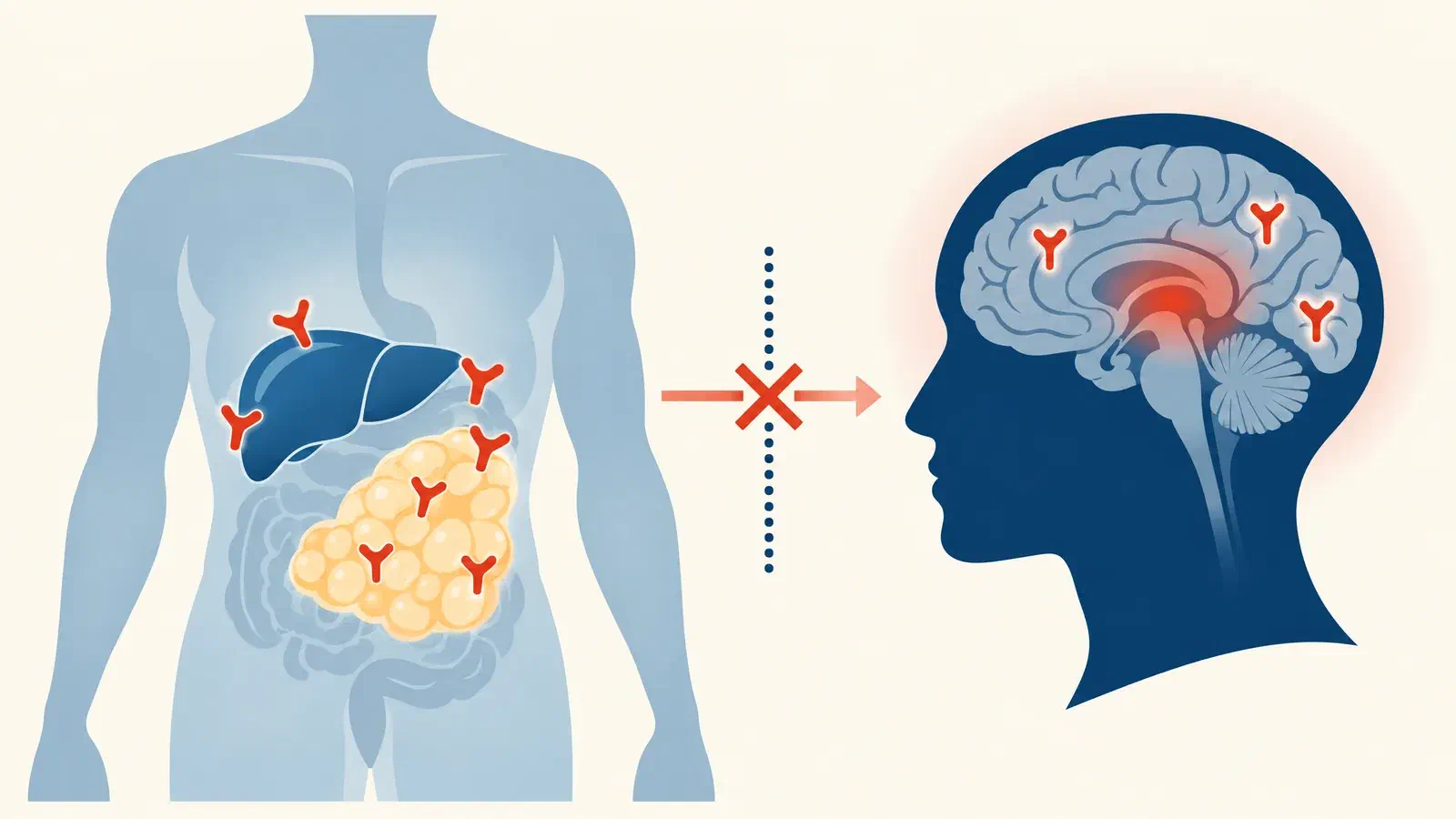
A weight-loss headline can look reassuring until you reach the side-effect paragraph. Monlunabant, previously called INV-202, brings that problem back to a familiar drug target: the cannabinoid type 1 receptor, or CB1. The experimental oral drug aims to limit brain exposure while blocking CB1 activity elsewhere in the body. But its obesity trial still recorded psychiatric side effects. You can't judge that trade-off from kilograms lost alone.
The Acomplia Report is the independent news archive that tracked rimonabant from its trials to its 2008 withdrawal. That history makes the new CB1 research more than another obesity-drug announcement. The question is whether researchers can preserve useful metabolic effects without repeating the harms that ended Acomplia's use.
What does monlunabant change about CB1 blockade?
A description such as “peripherally restricted” can sound like a safety guarantee. Say you're reading a trial summary over breakfast: you might reasonably assume a drug described that way cannot affect mood. The evidence doesn't justify that shortcut.
CB1 receptors occur in the brain and in peripheral tissues, meaning tissues outside the brain and spinal cord. Blocking peripheral receptors offers a possible way to affect metabolism without relying on brain receptor blockade. Our endocannabinoid system explainer provides the background to that distinction. 3
The new small molecule is a CB1 inverse agonist, also identified as MRI-1891. Wikipedia describes its peripheral selectivity and development by Inversago Pharma. Its company history records Novo Nordisk's agreement to acquire Inversago in August 2023. That acquisition brought the program into Novo's development work; ownership isn't evidence of clinical benefit. 1 2
An inverse agonist reduces a receptor's baseline signaling, rather than just preventing another molecule from activating it. The distinction matters because two drugs that both “block CB1” needn't have identical effects. Our guide to inverse agonists explains the terminology. 5
Knop and colleagues' 2025 trial report describes the drug as engineered to reduce brain penetration, not eliminate it. The authors say increasing psychiatric adverse events suggest brain penetration, while noting the lack of direct mechanistic evidence from well-designed human clinical studies. You can ask what “restricted” means at the tested exposure, rather than treating it as an absolute property. 3
What did the obesity trial actually measure?
Early announcements compress a trial into one attractive number. For example, a headline about weight loss over a few months may leave you wondering whether everyone assigned the drug stayed on it. That's where the full paper helps.
Phase 2a results were publicly reported in September 2024, as documented in Wikipedia's account. The peer-reviewed report followed in The Lancet Diabetes & Endocrinology in 2025. These are different reporting dates for the same development stage, not evidence that the treatment was approved in either year. 1 3
Knop et al. randomized 243 adults with obesity and metabolic syndrome at Canadian research centers. Of these, 242 received treatment. The study compared daily oral doses of 10 mg, 20 mg and 50 mg with placebo over 16 weeks. The investigators provided no lifestyle intervention or advice. Those details matter when you compare the result with a trial that includes intensive lifestyle support. 3
The monlunabant trial was funded by Inversago, and the sponsor contributed to its design, analysis and report. Journal peer review isn't the same as independent replication. You can weigh the results while looking for confirmation outside the development program. 3
The model-estimated placebo-subtracted weight loss—the extra loss compared with placebo—was:
- 6.4 kg at 10 mg, with a 95% confidence interval of 4.9–8.0 kg.
- 6.9 kg at 20 mg, with an interval of 5.3–8.5 kg.
- 8.0 kg at 50 mg, with an interval of 6.4–9.7 kg. 3
These figures describe group estimates, not a prediction for your weight. The intervals show uncertainty around each drug-versus-placebo estimate; they aren't the range of individual outcomes.
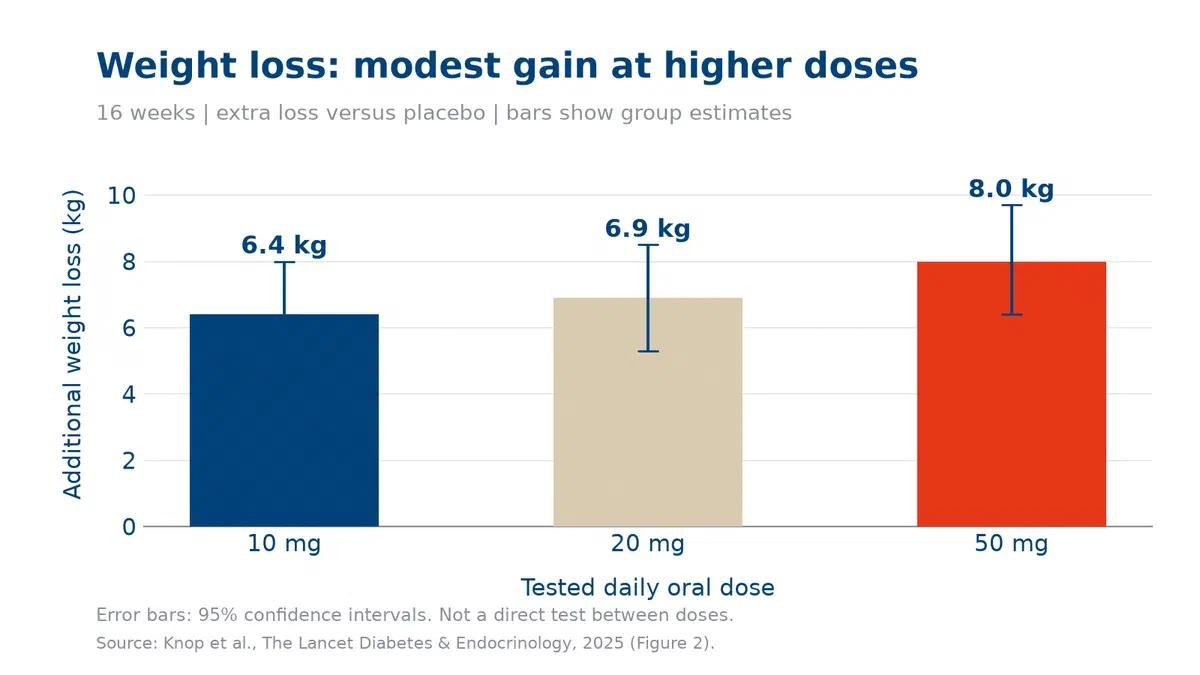
The higher dose's numerical advantage was limited: 8.0 − 6.4 = 1.6 kg more placebo-subtracted loss than the lowest tested dose. That subtraction doesn't prove superiority between doses. It does give you a concrete benefit to weigh against tolerability.
Why do the psychiatric events and withdrawals matter?
“Mild to moderate” can hide a meaningful disruption. Say someone in an experimental trial starts sleeping poorly and feels anxious before a morning commute. An event needn't lead to hospitalization to make continued treatment unacceptable.
Knop et al. (2025) reported anxiety in 13%, 10% and 27% of participants receiving the 10 mg, 20 mg and 50 mg doses, respectively, versus none receiving placebo. Depression was reported in 3%, 5% and 8%, respectively, versus none with placebo. Irritability and sleep disturbance also occurred. These are the paper's rounded percentages, and one participant could report several types of event. They shouldn't be added into a single psychiatric-risk figure. 3
No suicidality was reported in this trial. That's reassuring within this sample, but it doesn't establish that a rare risk is absent. The study was short and excluded significant psychiatric histories, including any history of suicide attempt or suicidal ideation. 3
The withdrawal figures are harder to dismiss. Adverse events led 8 of 61 participants (13%) to withdraw at 10 mg, 16 of 60 (27%) at 20 mg, and 25 of 60 (42%) at 50 mg. None of the 61 placebo recipients withdrew because of adverse events. The reported reasons included nausea, anxiety, diarrhea, irritability and sleep disorder—not psychiatric symptoms alone. 3
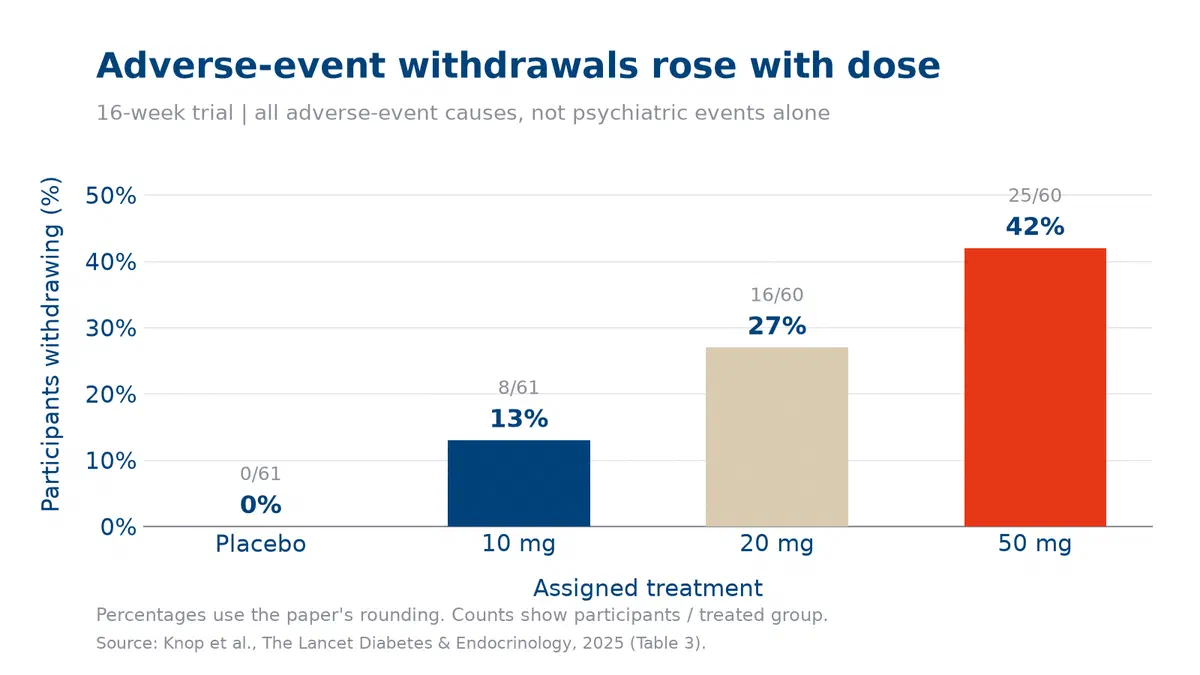
You can ask two separate questions: “How often did symptoms occur?” and “How often did symptoms make people leave?” The first measures occurrence; the second helps explain whether a benefit was tolerable. Neither number should replace the other.
Rimonabant showed why stronger warnings may not be enough
A warning can sound like a solved problem. For example, you might expect that excluding people with depression and checking mood regularly would make a risky drug acceptable. Acomplia's regulatory history shows why that assumption needs evidence.
On 23 October 2008, the European Medicines Agency recommended suspending Acomplia's marketing authorization. Its committee confirmed an approximate doubling of psychiatric-disorder risk compared with placebo. The regulator also said serious psychiatric disorders appeared more common in post-marketing experience and ongoing trials than in the original assessment. 4
The EMA had already strengthened restrictions and warnings. In July 2007, it recommended contraindicating the drug in people with ongoing major depression or receiving antidepressants. In May 2008, it recommended warning that depression could occur without obvious risk factors other than obesity itself. By October, the committee judged that further risk-reduction measures couldn't adequately address the psychiatric effects. 4
The archive's report on Acomplia being pulled from the European market records that turning point. Our rimonabant side-effects page preserves the earlier concerns.
This doesn't prove every new CB1 drug will fail. It sets a higher standard for a claim that monitoring alone will solve the problem. You can ask whether a proposed monitoring plan has been tested, who would be excluded, and what happens when symptoms appear between scheduled visits.
The EMA also noted that patients generally used Acomplia only briefly, limiting effectiveness in clinical practice. A drug's benefits depend on people being able to continue taking it. 4

Can a trial tell you whether a drug stays outside the brain?
An animal result can be mistaken for a human guarantee. If a summary says “low brain exposure,” you still need to know whether that observation came from animals, healthy volunteers or people taking repeated doses for obesity.
The full trial report acknowledges that psychiatric events raise concern about brain penetration. It doesn't establish the mechanism of each symptom. So the useful question is whether researchers have measured human brain exposure or receptor occupancy at the intended dose after repeated treatment. A design goal isn't a substitute for that measurement. 3
There's another gap: what happens after people stop? In this phase 2a trial, participants who permanently discontinued treatment also left the study, limiting later weight and safety information. The authors noted that week-16 primary-endpoint data were available for about half the high-dose group. 3
Their statistical model estimated outcomes using assumptions about missing data and a hypothetical strategy for treatment discontinuation. In everyday language, it aimed to estimate the effect of taking treatment as intended. It couldn't fully answer what happened to everyone offered the drug, including those unable to tolerate it.
That doesn't erase the weight-loss finding. But it makes “What did the missing participants experience?” a fair question. A future study would be more informative if it followed participants after treatment stopped, recorded symptom resolution and reported weight outcomes despite discontinuation. You shouldn't have to assume that leaving a trial means a problem resolved.
Does nimacimab offer a different route?
A shared receptor target doesn't make two medicines interchangeable. For example, a weekly antibody injection and a daily small-molecule tablet may both inhibit CB1, yet differ in where and how they act. Safety can't be borrowed from one approach to the other.
Hanafy et al. (2025), in ACS Medicinal Chemistry Letters, describe nimacimab as a monoclonal antibody that acts as a negative allosteric modulator of peripheral CB1. “Allosteric” means it acts at a site distinct from the receptor's main ligand-binding site, altering receptor activity. This is a different molecular approach from an oral small-molecule inverse agonist. 5
The CBeyond phase 2 record, NCT06577090, compares nimacimab with placebo and also compares nimacimab plus semaglutide with semaglutide plus placebo. The main weight endpoint is at 26 weeks. The registry record updated in January 2026 displayed no posted results. Registration describes the experiment; it doesn't certify effectiveness or safety. 6
The combination comparison is useful because it asks whether the antibody adds benefit beyond semaglutide. Without that control, weight loss on a combination can't show which component contributed what.
The protocol also excludes major depressive disorder, antidepressant use and a lifetime history of suicide attempts, among other conditions. That limits how broadly a reassuring result could apply. 6
You can ask for complete human results, adverse-event denominators and post-treatment follow-up before accepting claims of psychiatric safety. The antibody approach deserves testing. It doesn't deserve an exemption from the questions raised by rimonabant.
FAQ: questions about the new CB1 drugs
Drug names often move faster than clear explanations. If you've saved a headline on your phone, these are the distinctions that keep an experimental treatment from being mistaken for an established option.
Is monlunabant the same as INV-202?
Yes. INV-202 and MRI-1891 are earlier identifiers for the same investigational molecule. Different names don't mean separate drugs or independent sets of trial results. 1 3
Is it an approved obesity treatment?
The evidence discussed here concerns an investigational treatment, not an approved prescribing option as of this article's May 2026 date. The tested doses are research details, not instructions for personal use. 1 3
Does peripheral CB1 blockade prevent depression?
That hasn't been established. Depression and other psychiatric events occurred in the small-molecule trial despite its reduced-brain-penetration design. The degree of restriction and actual human safety both need evidence. 3
Is nimacimab proven safer than rimonabant?
The sources reviewed here don't establish that comparison. Its antibody mechanism differs, but an early trial or a registered protocol can't prove long-term psychiatric safety. 5 6
A new CB1 drug needs a tolerable dose, not just weight loss
A lower dose may sound like an easy fix after a high-dose safety signal. But “less drug” doesn't automatically mean enough benefit with acceptable harm. The lowest tested dose still had adverse-event withdrawals, so the next study needs to demonstrate a usable margin between benefit and risk. 3
For a conversation with a clinician or trial investigator, you could bring these questions:
- What human evidence supports limited brain exposure at this dose after repeated treatment?
- Were people with my psychiatric history or medications represented, or excluded?
- How were mood and sleep assessed, and who could respond between study visits?
- Did researchers keep following people who stopped treatment, including whether symptoms resolved?
These questions connect the proposed drug to your circumstances without assuming that either an encouraging headline or an old failure settles the answer. The Acomplia Report doesn't sell drugs or provide individual medical advice.
The deciding evidence will be a dose that people can tolerate over time, with psychiatric outcomes recorded even after treatment stops. A smaller number on the scale can't supply that missing follow-up.
References